Category Archives: B&W Photography

The Palouse Sky

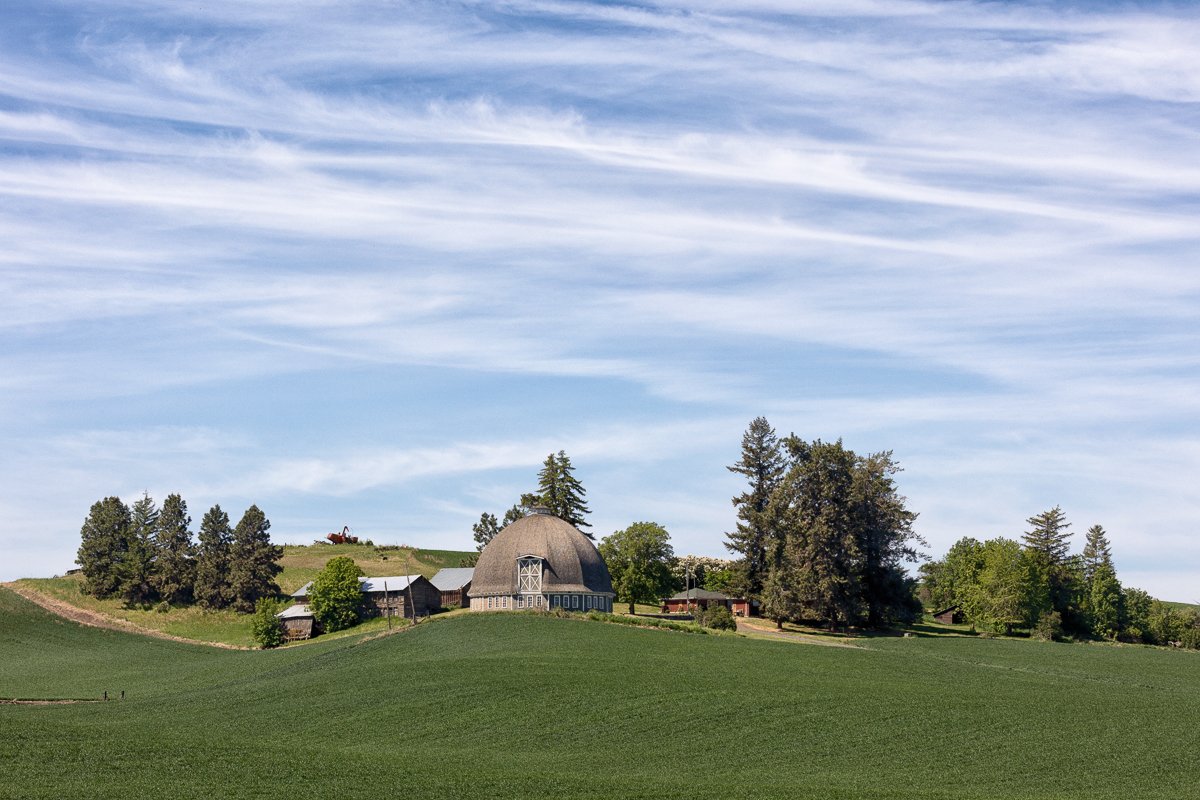
“Two White Barns and Steptoe”
The Palouse, Washington

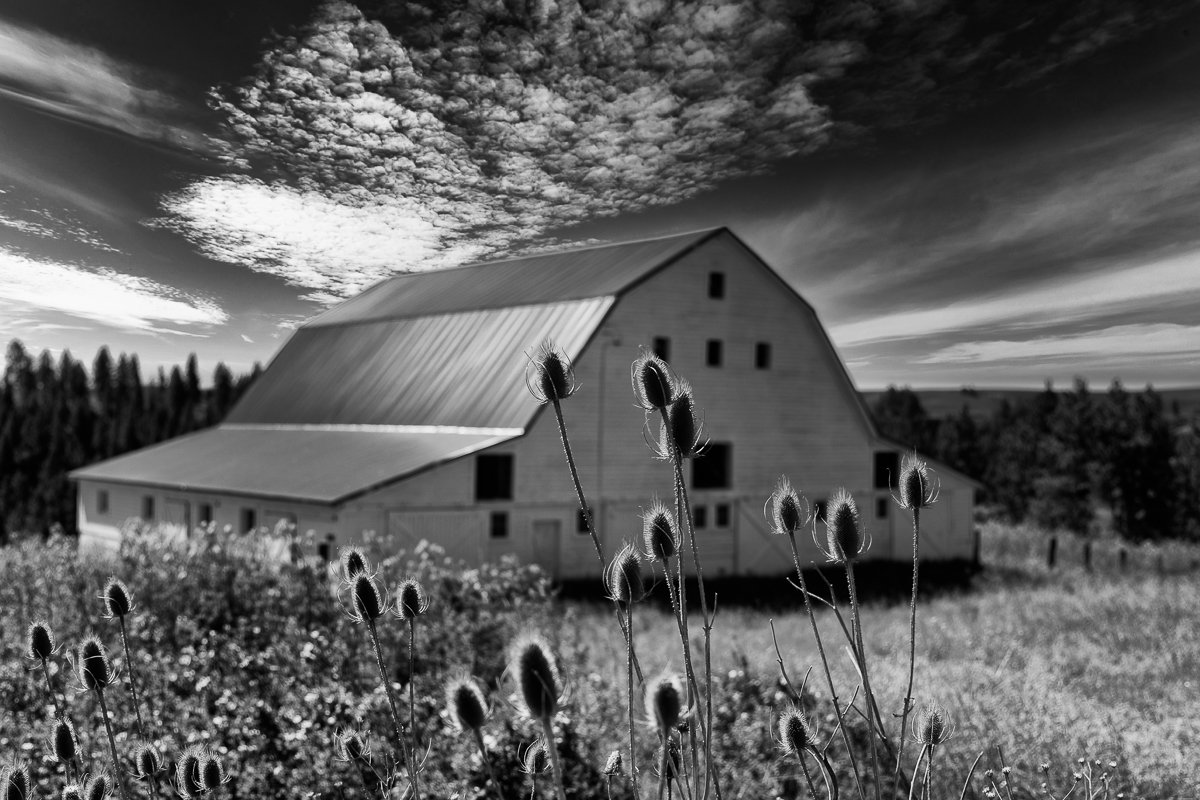
I started out searching for these iconic two white barns in the fields of the Palouse. I first focused my images on the two white barns. I wasn’t excited about what I had created. They were just nice photos of two white barns. I stepped back and asked myself why I was making the images. It was the wonderful Palouse sky and the quaint farm setting in the rolling hills around Steptoe Butte. I switched my perspective to the overall setting and away from the iconic barns.

Related Images:
Memories of the Past

“Old Skeen Schoolhouse”
The Palouse, Washington

Wandering country road, old farm equipment, and an old school house … how many memories do these represent? One hundred and fifty years of history have changed this area from sagebrush and native grasses to some of the richest dry land farming areas in the world. Decades of dilapidated used farm implements are scattered across the area. The old one room Skeen schoolhouse once served the children of the pioneer families.

As we were photographing, an old farmer who lived across the street came over to check up on us. What an opportunity would it have been to just sit down and and spend a couple of hours listening to him talk about the “Good Ole Times.”

Related Images:

Sad…

“Last Days”
The Palouse, Washingto
n

For years, this tree was a cornerstone of a SW view from Steptoe Butte. It anchored a vignette of lush green (spring), golden tan (harvest), and contrasting dark and light browns (after plowing). I had last seen it during the fall of 2019, pre-Covid. It still had all its leaves and looked healthy (at least from a distance). When I saw it from Steptoe this spring during a severe draught, it had lost most of its leaves. I am afraid that this stately giant is in its last days.

On the last day of our workshop, several of us went out to photograph the tree up close. I made images from several different perspectives, but nothing seemed to express the sadness I felt seeing the tree in its dying state. Most of my images were of the lone tree against a background of rolling green hills and a cloud dotted sky. It seemed lonely, just left to die. Then I looked up and zoomed in to focus on the strong stately branches still reaching out. This is how I want to remember it.

Related Images:

Death Valley or the Palouse?

“Wheat Dunes”
The Palouse, Washington

Conversation to myself: Squinting my I eyes I ask, “Where am I?” “Are these the rolling dunes of Death Valley? I thought I was in Eastern Washington. There are sand dunes in Eastern Washington. Aren’t there?” I slightly open my squint and see a shade of green. “No, this isn’t Death Valley.” I open my eyes further and see the textures of young winter wheat. “It’s the Palouse!”

Related Images:

Last of its Kind Standing

“Barron Flour Mill”
Oaksdale, Washington

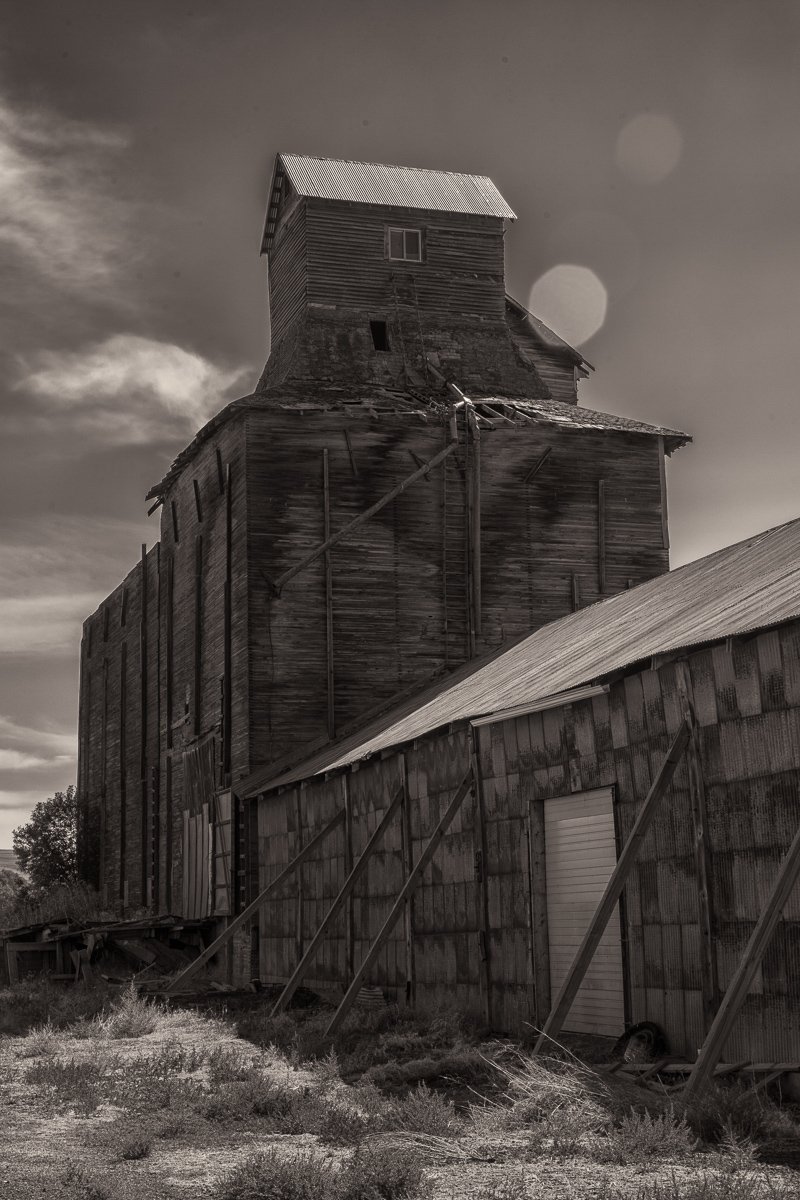
This old mill has quite a history. The mill was built in 1890 by J.G. Porter and sold to Harvey Gray. Joseph C. Barron, Sr. bought the mill from Gray in 1907 for $11,500. Joseph C. Barron, Jr. was born in 1909 and joined his father in the business. Junior took over the business and ran the mill until 1960 when he could not compete with the modern facilities. Barron then put in a small modern mill, capable of producing 500 lbs. per hour, in a small building behind his house. He ran the new mill until 1997. At the age of 88 he felt that it was time to retire and sell both his new mill and the old Oaksdale wooden mill to Mary Jane Butters. Mary Butters had worked with Barron for several years and is the owner of Paradise Farm Organics, Inc. which markets organic and heirloom grain products.

The Barron Mill is the only intact flour mill remaining in the Palouse. It has been placed on the National Register of Historic Places in 1978. It is my dream to be able to tour the old mill some day in the future.

Related Images:

An Anomaly

“Steptoe Butte”
The Palouse, Washington

The Columbia River Lava flows make up most of the bedrock of the Palouse. Fifteen to eighteen million years ago fissures in southeastern Washington, northeastern Oregon, and southwestern Idaho spewed out great lava flows over the Columbia Basin. Steptoe Butte created by a metamorphic rock protrusion 400 million years ago rises 1000 feet above the lava flows.

Related Images:

Almost Missed

“White Barn”
The Palouse, Washington

We were hot and tired after a morning photo excursion during a Palouse Photography Workshop with John Barclay. Driving along headed back to the hotel for a break and maybe a nap, I saw this lone white barn. We glanced back as we zipped bye the barn. “Should I stop or should we just go back to the hotel.” On I went, thinking, “I should have stopped, I should have stopped!” I dropped my ride partner off at the hotel and decided, I am going back. I am glad I did.

Lesson Learned: When I see something, STOP! It may or may not be worth creating an image, but at least the memory will remain.

Related Images:

Exploring the Back Roads

“Lonesome Road”
The Palouse, Washington

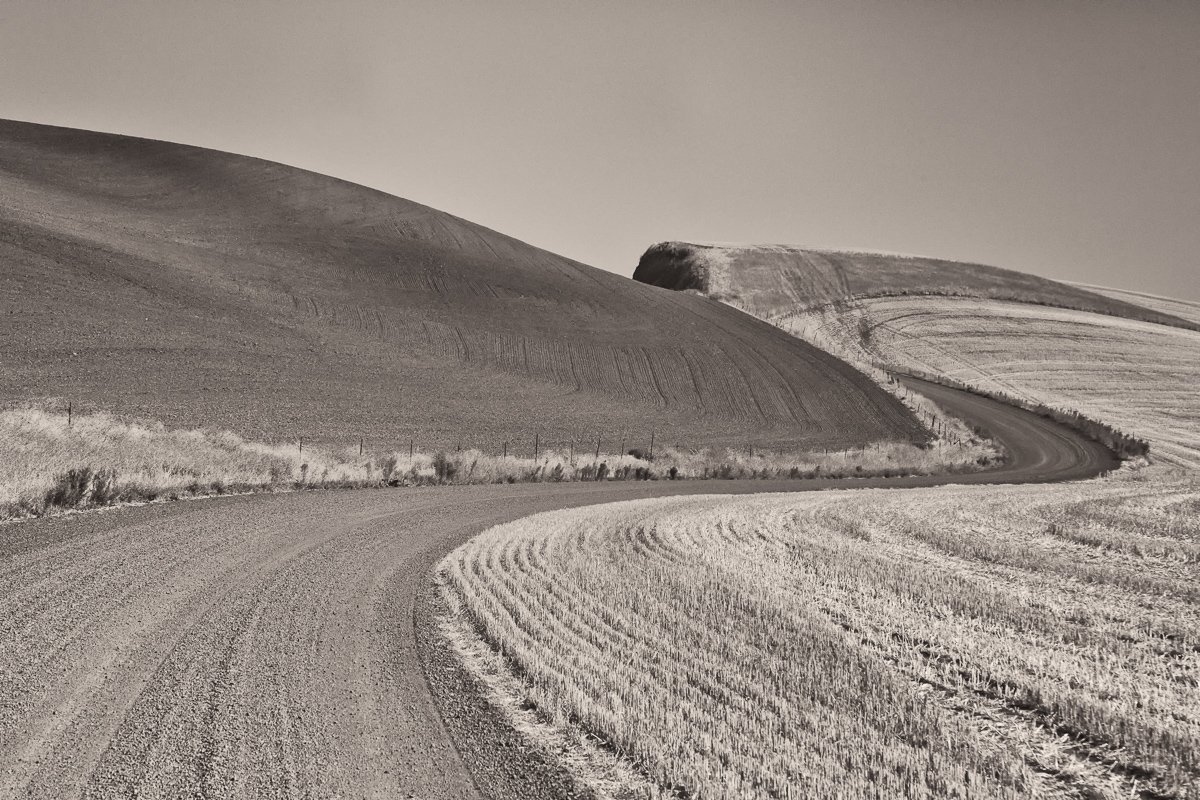
One of the things I enjoy the most is just driving around exploring the countryside. An old dirt road, rolling hills, puffy clouds puts my mind at peace. I stop in the middle of the seldom traveled road not worrying about another car or truck coming by. I pause and enjoy what I see around me and contemplate how this beautiful land has been used to support a long abandoned homestead and now as a section of a large mega-farm. Sometimes I create an image with my camera. Sometimes I just drive on with the image as a memory in my mind.

Related Images:

Patience

“Sunlight on the Curves”
Palouse, Washington

Springtime in the Palouse is a wonderful time to practice my skills using infrared photography. The bright green winter wheat and the great clouds add to the experience. It was a cool windy day with rapidly moving clouds. Patches of sunlight rolled along the hills. I spent about an hour and created almost 100 images trying to catch different patches of sunlight crossing the two curvy hills at the same time. Patience paid off as I was able to catch the bright strips of sunlight on the two ridges.

Related Images: