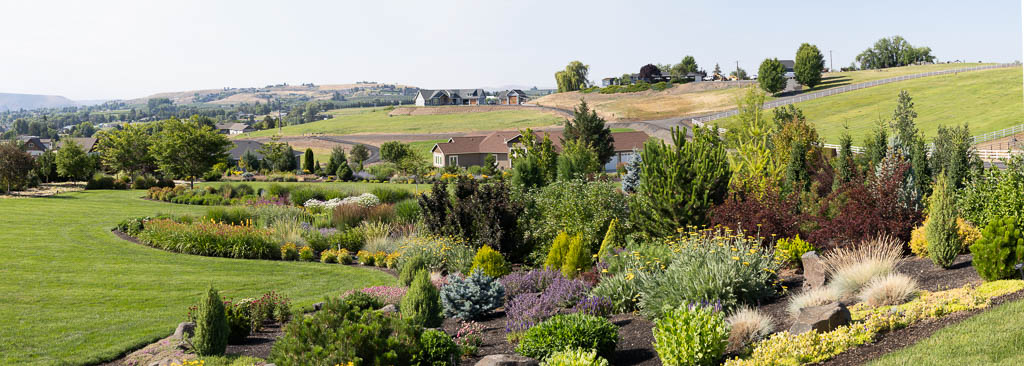
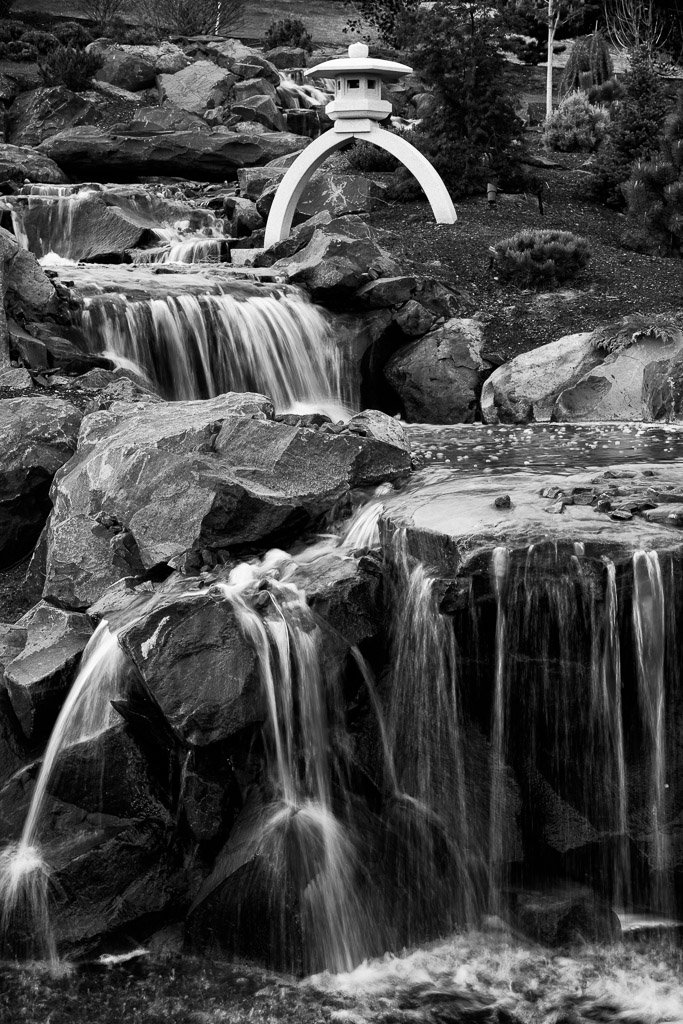
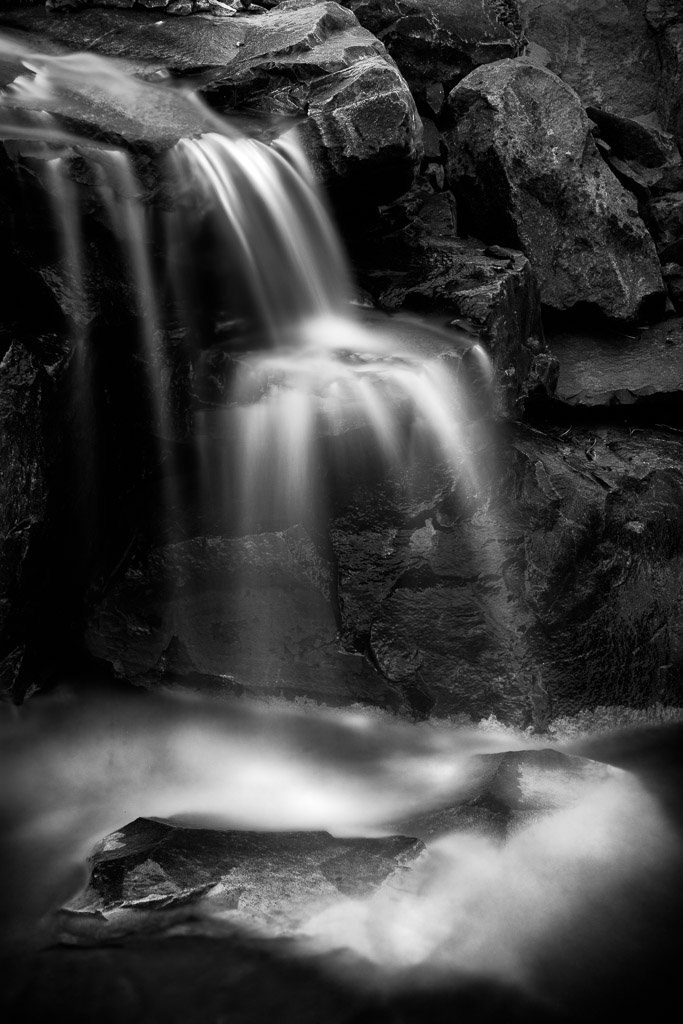
This post will start a series of images depicting nature’s little wonders. These images are from a photo excursion I took in the Yakima Arboretum over a year ago. From time to time, I give myself an assignment to practice a specific type of photography. This trip I focused on looking for little things that caught my eye whatever they might be. Some were abstracts, others were macro details of pieces of nature.
Interesting bark was one of the things that caught my eye. The texture and color contrasts of the peeling bark of a paperbark maple (Acer griseum) creates a beautiful abstract that highlights a winter scene. We have planted two acer griseums in our yard, one at the entry of our Japanese garden and one in the middle of our front lawn. They are striking in the summer and gorgeous in the winter, especially covered with a little snow.
This image continues the theme from my previous post. The colors in our new meadow are striking. Adjacent colors were actually laid out using a color wheel. Here, opposite colors were planted next to each other to create the color contrast. Here again Monet’s perspective comes to the rescue.
This is another example of “Isolation.” My mission for this photo excursion was to collect isolated macro images that represent the early autumn of our Japanese Garden. I am in the process of preparing annual image collections of how our Heatherwood Garden changes from season to season throughout the year. For this specific photo shoot, I walked around the Garden and tried to collect compelling images that would represent the details of our autumn garden.
The uniqueness of this image is that is illustrates the yearly life cycle of a dogwood tree bloom. The yellow protrusions are the remnants of the spring blossom sepals; the leaves are turning to their autumn color before they fall for the winter; the red berry is the fruit for the wintering birds, and the purplish bud is the future blossom for next spring. The dew drop adds additional interest while the tips and edges of the leaves draw the viewers eye to the subject.
I have recognized that I have recently fallen back on making nice snapshots versus compelling images. I tend to fall back into “ruts” from time to time. During this period of “social distancing” and my surgery recovery time, I am looking back on some lessons I have taken on-line from David DuChemin.
The focus on this image is “Isolation.” My exercise last fall was to isolate and enhance the subject and eliminate distractions. My target subject was the Kotoji. I walked around our Japanese Garden to first identify a perspective of the Kotoji that was different from the many that I had taken before. I collected images of a tightly cropped full Kotoji lantern, close-up of detailed Kotoji elements, the Kotoji with the foreground and background, etc. I then continued to walk around and tried to frame the Kotoji with other elements in the Japanese Garden. Finally I worked on creating a “peek” of the Kotoji through a background Japanese maple.
To focus on the subject, I set my focal point and exposed for the front edge of the lantern’s top. The lantern was framed with a void through the Japanese maple. I used a narrow depth of field to blur the maple tree leaves and branches. In post processing, I further blurred and darkened the surrounding leaves and branches to lead the viewers eye to the Kotoji.
This image is not one of my best, but it was an excellent learning experience to purposefully focus on creating a compelling image.
Dogwood Bloom Against Japanese Maple Heatherwood Spring
As I stroll along in our Heatherwood Garden, I always have a camera, at least my iPhone, with me. This Spring, our variegated dogwood only had a few blossoms and they were 7-8 feet from the ground. I looked around to see if I could get a good sky background, but all we had were grey nondescript clouds. I stood on my tip toes extended my arms and tilted the iPhone down just a bit to pick up the deep red of a Japanese Maple as a background. It pays to be tall.
I don’t have to go far for a photographic safari. Everything I need is in our back yard.
Space Shuttle Atlantis Abstract Kennedy Space Center Museum, Florida
We have finally returned to launching Americans on a US launch vehicle from US soil. The SpaceX launch vehicle with the Crew Dragon onboard provided this signifiant milestone in our revitalized Space Program on 30 May. We have a new horizon of Space exploration ahead of us with defined programs to return to the moon and send Americans to Mars. This will happen in my life time!
I remember the launch of the Sputnik when I was in grade school. This was followed by our country’s aggressive program to put a man on the moon by the end of the decade. I remember the Gemini Program highlighted by Shepard’s first flight into space and John Glenn’s record orbit around the earth. I remember the failures and successes of the Apollo program, culminating in Armstrong’s first step on the Moon in the summer of 1969. I also remember the miracle of Apollo 13.
While at Boeing, I had the opportunity to work with several of the engineers and leaders who were an integral part of the Apollo Saturn V rocket program, the Lunar Rover program and the Space Shuttle program. I moved to Washington, DC and was Boeing’s technical liaison between our Seattle staff and NASA. I met Michael Collins, the astronaut who stayed in the command module while Armstrong and Aldrin walked on the moon. I worked with General Abramson, the ex-Shuttle Program Manager, on Strategic Defense Initiative programs. I watched the Challenger disaster with several of my Boeing associates in our Washington, DC Control Room. One of my bosses became the leader of the Space Station Integration program. I was part of our National Space Program.
When we exited from space launch programs with the last Shuttle flight in 2011, I felt a deep loss of US leadership in Space. Now after 9 years, we have made our first significant step toward the World’s New Horizon. We have returned … How proud it makes me feel.
“Hosta, Japanese Maple, & Ground Cover” Fountainville, PA Garden
Tones, textures, and shapes all combine to provide vignettes of enjoyment for me. Simple things perk my interest. I first see the bright chartreuse of the hosta jump out at me. I stop, focus, and follow the lines and shapes of the leaves. I am drawn into the details. The dense and darker ground cover creates a base supporting the hosta leaves. I raise my eyes and see the small, delicate leaves of the Japanese Maple trickling down over the large hosta leaves protecting them from the bright sun. What a wonderful moment I experience just enjoying the simple beauty of a garden.
It took many years to create this vignette. First, we dug up a portion of our yard and added a good quanty of fill dirt and top soil to create a planting bed. We edged the bed with Pennsylvania blue stone to keep the dirt from flowing over to the grass and gravel walk way. Our first planting was a bed of petunias. They were beautiful but took a lot of maintenance to keep them looking neat. After a couple of years, we planted a Sango Kaku Japanese Maple on the corner of the bed. We planted several sun loving plants around the base of the maple and patiently waited until the maple created enough shade to plant shade-loving plants. We gradually pulled out and transplanted the sun-lovers and replaced them with hostas and other shade plants. Over the years the ground cover spread as the hostas grew. The bottom branches of the Sango Kaku flowed down to provide the shade the hosta needed. Fifteen years after we moved in, we had a beautiful bed with Japanese Maples at each end, medium sized shrubs in the middle, and all the ground covered with ground cover and shade-loving plants. Small vignettes were scattered all around.
Now on the other side of the country, we are starting over to develop a landscape that will have a similar feeling. Now we have small trees and shrubs and a lot of sun-loving plants. The areas between are covered with bark. We patiently will wait for nature to do its work to develop the mini environments to create vignettes like the one above. We celebrate the little things that make up the wonder of nature and life.
Pinus cembra ‘Algonquin Pillar’ Heatherwood Spring
Today’s post is for my friends in the Northeast. From what I see in the news your are being hit with an Arctic blast with some temperatures below freezing and maybe even a little snow. It’s the first week of May … this is not suppose to happen. Today in Eastern Washington, we expect to see temperatures in the high 70’s. So I thought you would appreciate a little brightness and warmth.
This image is the tip of one of our speciality pine tree branches breaking out in new needles and cones. We have selected several non-common pine and spruce species to create a little evergreen grove on the southeast corner of our property. This little guy is showing off its spring glory. I look forward to watching as it matures through the season.
Remember back in a previous post (March 22) I presented a viburnum that was just getting ready to bloom? I thought it would burst open the next day. I kept going out every day checking for its progress. Leaves started to come out, but nothing seemed to be happening with the blossom buds. Then last week, all of a sudden the whole plant burst open in bloom. Well it took almost 4 weeks for the viburnum to reach its full bloom. Patience pays off! One week later, most of the blooms have been blown off the plant. Oh well … It was beautiful!
Walking around the Yakima Arboretum’s crabapple collection is a real treat. I made three trips there this Spring. One day I noticed a young lady walking around and taking closeup images of the crabapple blooms with her i-Pad. Her partner was patiently sitting on a bench waiting for her to finish. The next day I came back again and saw the same lady taking more photos with her i-Pad. And, her partner was sitting on the bench again. Beauty attracts photographers. If it weren’t for “social distancing” I would have asked her if she was just enjoying the beauty of the garden like I was, or was she doing some special project.
The beauty of the majestic ancient crabapples in the Yakima Arboretum has inspired me over the years. It is one of the largest crabapple collections in the country. Almost all of the trees are very old. Some are on their last leg. Over the years the Arboretum has not added new trees to take place of the ones which are past their healthy prime. This will be one of the challenges that the Arboretum will address in the new Master Plan. Anyway, the grove still inspires me to the point that I have decided to create a small crabapple grove of my own in the “lower 40” of Heatherwood. One dark pink crabapple was planted in the garden by the previous owner. It anchors the northeast corner of our house. This spring we will plant a white weeping cherry to complement it. On the “lower 40” we are planting a mini-collection of seven different crabapples to frame in our meadow area. Some are blooming now, so we can get a glimpse of what is to come in the years ahead.