Here is to more color in the meadow. This time we’ve added a little orange to the yellow and purple. The patches of color are separate, but gently blend into one another. The yellow provides a little buffer between the orange and the purple. What a summer treat our new meadow brings us.
Clumps of yellow “Red Hot Pokers”. (Kniphofia uvaria) are scattered in several places around the meadow. They are the stars of the current blooming meadow perennials. They stick out like blazing candles on a birthday cake.
This image continues the theme from my previous post. The colors in our new meadow are striking. Adjacent colors were actually laid out using a color wheel. Here, opposite colors were planted next to each other to create the color contrast. Here again Monet’s perspective comes to the rescue.
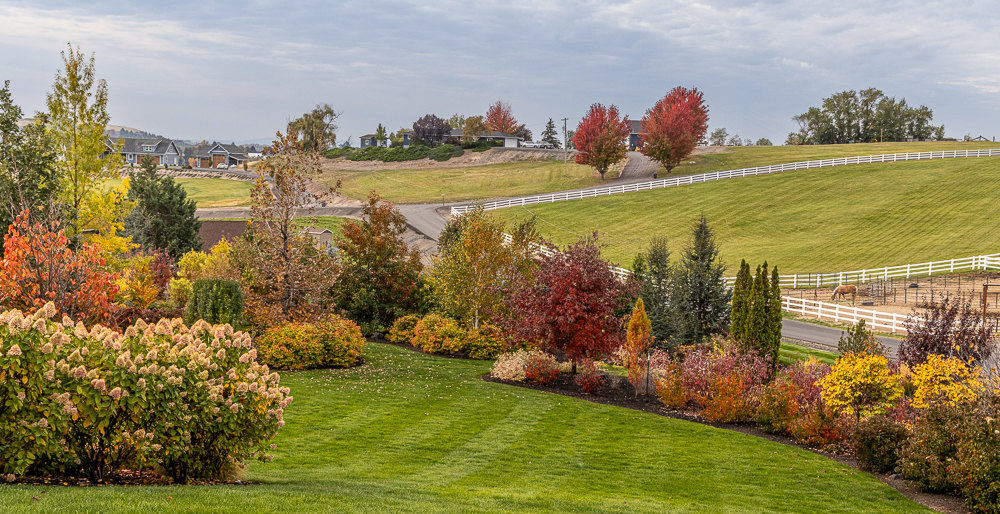
We just finished carving out and planting a new meadow in the lower section of Heatherwood. The colors are already bursting out for its first summer season. Reds, purples, yellows, blues, oranges, and all different shades of greens are scattered about. We have a lot of bark covered ground showing through most of the areas. It will take a few years for the perennials to fill in. We have patience and are enjoying the individual plants as each one breaks into bloom. Hopefully we will have a flow of changing color throughout the summer and early fall. This is just a start. We will record the activity of the meadow and adjust as we go along. It will also be a “Never Ending Journey.”
I created this image today. It was my first time out photographing since I had my foot operation. I’ve been hobbling around for the past three plus weeks. I still can’t put any weight on my foot, so I got a little creative and hopped on my lawn mower and drove around our new garden meadow. I stopped and recorded many images from above. Getting the best perspective and composition was very difficult, and sometimes impossible. But, I just had to get out with my camera. When I started processing the images, I noticed that they were all a little out of focus. I guess the high frequency vibration of the lawn mower didn’t help my unsteady hand. So, I decided to cheat a little and convert the images into a blurred impressionistic versions. Thank you Topaz!
“Looking Into the Oak Grove” Yakima Arboretum, Washington
This image of oak trees in the Yakima Arboretum found me this spring before the Covid-19 restrictions. Luckily the Arboretum was allowed to remain open during this period. I was able to make several other visits to see the cherry tree bloom, the magnolia bloom, and the crabapple bloom. Several times I felt that I had the Arboretum to myself. It was a great time to just wander and let images come to me.
My walks through the Arboretum help me visualize what our little place in Selah could be in 15-20 years. This spring we planted five oak trees. We have spaced them out to create a grove where we will be able to watch them grow. It will take several years for them to be tall enough to support an understory of smaller trees and shrubs. In the meantime the grove will look bare, but I will be able to squint my eyes and imagine what it will be like when they mature.
I have recognized that I have recently fallen back on making nice snapshots versus compelling images. I tend to fall back into “ruts” from time to time. During this period of “social distancing” and my surgery recovery time, I am looking back on some lessons I have taken on-line from David DuChemin.
The focus on this image is “Isolation.” My exercise last fall was to isolate and enhance the subject and eliminate distractions. My target subject was the Kotoji. I walked around our Japanese Garden to first identify a perspective of the Kotoji that was different from the many that I had taken before. I collected images of a tightly cropped full Kotoji lantern, close-up of detailed Kotoji elements, the Kotoji with the foreground and background, etc. I then continued to walk around and tried to frame the Kotoji with other elements in the Japanese Garden. Finally I worked on creating a “peek” of the Kotoji through a background Japanese maple.
To focus on the subject, I set my focal point and exposed for the front edge of the lantern’s top. The lantern was framed with a void through the Japanese maple. I used a narrow depth of field to blur the maple tree leaves and branches. In post processing, I further blurred and darkened the surrounding leaves and branches to lead the viewers eye to the Kotoji.
This image is not one of my best, but it was an excellent learning experience to purposefully focus on creating a compelling image.
What a wonderful gift was given to me while meandering along some back roads north of Walla Walla in the Palouse. Layers of clouds were moving above. It was breezy and fairly dark. It felt like a storm was about to come in. I had an eerie feeling around me. My partner stayed in the car while I ventured out.
I took a long exposure to capture the movement of the clouds. I looked at my image and got excited as I saw rays emerging from the barn almost fighting with the clouds moving across the image. Two different air streams were layered on top of each other. One set of clouds was moving easterly while the other was moving south easterly toward me.
It is time for me to go to the Palouse to wander again. The rolling hills, old homesteads and clouds are calling. Hopefully some local travel will be possible in the relative near future.
Dogwood Bloom Against Japanese Maple Heatherwood Spring
As I stroll along in our Heatherwood Garden, I always have a camera, at least my iPhone, with me. This Spring, our variegated dogwood only had a few blossoms and they were 7-8 feet from the ground. I looked around to see if I could get a good sky background, but all we had were grey nondescript clouds. I stood on my tip toes extended my arms and tilted the iPhone down just a bit to pick up the deep red of a Japanese Maple as a background. It pays to be tall.
I don’t have to go far for a photographic safari. Everything I need is in our back yard.
One of my focal areas for photography is public and private gardens. I couple this interest with collecting ideas for our own landscape development of Heatherwood. Many of my photographs are simple records of interesting things elements. For others, I try to create an image that reflects the feeling I have for a specific garden design. Yet, for those special ones, I try to create an image that provides a unique perspective of what I see. My adventure through a garden is multi-dimensional. Many times I come up with ideas, but no real “keeper” images. Other times I leave with a nice portfolio of images that presents the beauty of my visit. Other times I come up with a few (maybe one) images that I feel illustrate a little creativity.
The above image is one where I am trying to create the feeling that I experienced when I saw this vignette. It is a peaceful setting where I could relax in the shade, enjoy the beauty of what is around me, and contemplate what is right with this world. It represents a design element that I am trying to create with portions of our Heatherwood landscape. Of course, here in Central Washington, the moss covered trees and tropical vegetation will be replaced with conifers, local trees, and understory vegetation.
Shin Deshojo Japanese Maple Heatherwood Japanese Garden
How fast things change. The initial color of the first emerging leaves of this Shin Deshojo is a light pinkish red. Within a week they had turned to this brilliant red. Now, a month later, the leaves are a greenish-red color. Soon they will be a medium green. And then in the fall, they will be a brilliant red again. What a wonderful show this little tree gives us over the year.
The different and changing colors of our 26 Japanese Maples consistently catch my eye. Every time I walk through the garden, I look for something different. It is easy to find.