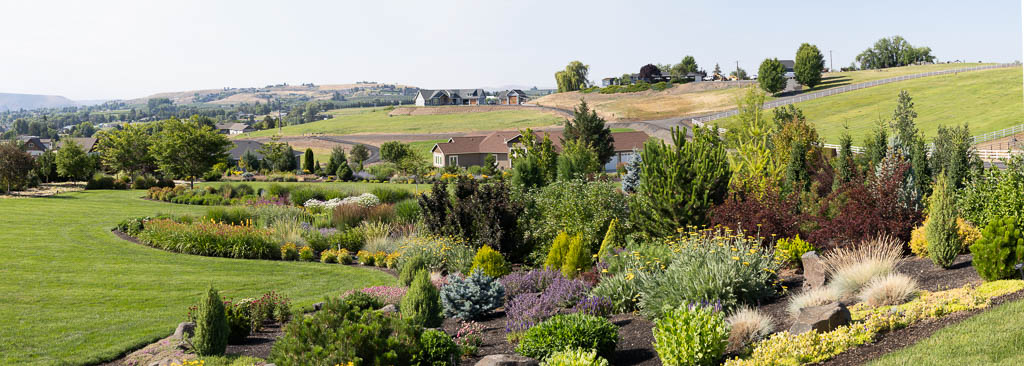
“Hillside Ground Covers” Heatherwood Japanese Garden
The above image illustrates what we are trying to do with ground covers throughout our Japanese-influenced garden area. As the garden matures, ground covers will fill in the majority of barked areas. They provide color and texture contrasts complementing the evergreen and deciduous shrubs. They soften the hard rocks as they grow around and over them. They change color from summer to winter providing special color highlights throughout the year. Ground covers are the focus of our 2022 Heatherwood landscaping project.
As the winter season gets ready to turn to spring, Heatherwood’s winter color continues to become more dynamic. It is hard for me to let go of the winter color and start to trim the winter grasses and last year’s perennials back to make room for the new growth. But spring is rapidly approaching and I must start cutting back last year’s spent growth. The garden will look a little bare for 3-4 weeks, but soon the new growth will start to present itself for the glory of spring.
“Fill in the blanks” is the motto for our 2022 Heatherwood landscape projects. This section of our garden was constructed in 2019. The land was shaped and the base structure of trees and evergreen shrubs were planted. During the next two years additional trees, deciduous shrubs, and limited ground covers were planted to balance the structure and form the garden borders. This year our plan is to fill in the blank spots with various ground covers and just watch the garden grow. It is our vision to have the garden fully covered with various vegetation and understory shrubs shaded by a canopy of evergreen and deciduous trees. It will take years to achieve the vision. Patience will be a virtue as we enjoy watching the garden mature. We are planting for the future generation!
There is still a lot of winter interest in Heatherwood. The skeleton structures of the Japanese Maples provide interesting winter forms. The reds, yellows, and greens of the evergreen plants provide highlights through the garden. Good weather is predicted through the first couple weeks of March. It’s time to get our and start our winter/spring clean-up and pruning.
It is hard to believe that spring is only three weeks away. Yesterday we took a long walk through the garden with a notebook in hand. We made a survey of the garden and jotted down all of the little things that we needed to do in the garden in the early spring. We have a lot of work to do. We plan to start our winter/spring clean-up this week.
During our walks in the garden I always note special little things that catch my eye. The image above is a spent bloom of a tulip tree we planted last spring. It is a reminder of the tree’s beautiful blooms that will come out this summer. Last year, we got busy and missed the peak of the bloom. This year, we will keep our eye out for the two or three blooms that may emerge on our “baby” tulip tree.
After the shadow of record-setting freezing temperatures, our first crocuses start to emerge. They provide hope that spring is just around the corner. In a similar fashion, I contemplate and pray that our world’s humanity will overcome the shadow that the Russian invasion of Ukraine is causing.
As I write this post, Russia is invading Ukraine. The world is a crazy place right now. I have the hope that “cool heads” around the world will prevail and that a global crisis will be avoided.
“Blue Rug Juniper and Woolly Thyme” Heatherwood Japanese Garden
Many times I walk through our garden with my camera focusing on a simple objective. Contrasting colors and textures in our winter garden was my photographic theme during this day’s garden stroll. I consider our Heatherwood garden as one big experiment. This little vignette is the result of two seasons growth of a creeping juniper and a soft-textured thyme. It provides a tight contrasting ground cover in our Japanese influenced garden. More thyme has been ordered for this year’s planting project to provide additional interesting ground cover for the garden.
Little things frequently catch my attention during my garden strolls. I almost always have a camera with me to record my thoughts. Liquidambars (American Sweetgum) have caught my interest for many years. Their beautiful multi-color fall foliage first caught my eye in a nursery near Woodinville, WA in the late 80’s. I purchased two and planted them at our driveway’s entrance. An ice storm following a heavy snowfall bent the trees to the ground and broke off several branches. The trees never really fully recovered.
My next experience was in Pennsylvania where I again saw the beautiful fall color of a row of sweetgums lining a local nursery. I quickly bought six trees to line the edge of our yard along the road. Fifteen years later, they were the highlight of our neighborhood’s drive.
I am on my third trial here in Central Washington. Two years after I moved in, I planted two more Liquidambars, one on each side of our driveway. They grace our front yard with lush green foliage in the spring and summer, beautiful fall color, and the weapons shown in the image above in the winter.
When I look at these spiked seed pods, they remind me of a spiked medieval weapon called a flail. I don’t want to think how it would feel to be hit by one. However, I have felt the excruciating pain of crawling around on the ground weeding beneath a tree and kneeling on one of the spiked seed pods.
A few days ago, we were walking along the new path of our irrigation pipeline when I stopped and gazed down through the Selah Valley into Yakima. What I saw was an excellent near ground-level perspective of the Yakima Folds. It made me stop and contemplate how the Yakima Folds were created and how they affected the way our local communities evolved.
The Yakima Folds were created 15.6 million years ago when opposing tectonic plate movement compressed the landscape, causing fold-like ridges to be created. The above image was taken from the base of Selah Ridge, north of Selah, looking down the throat of the gaps created by the Yakima River. The first set of ridges is the Yakima Ridge which separates Selah from Yakima. The second set of ridges are the Ahtamum/Rattleshake Hills Ridge which separate the city of Yakima from the lower Yakima Valley. The ridges in the far background are the Horse Heaven Hills.