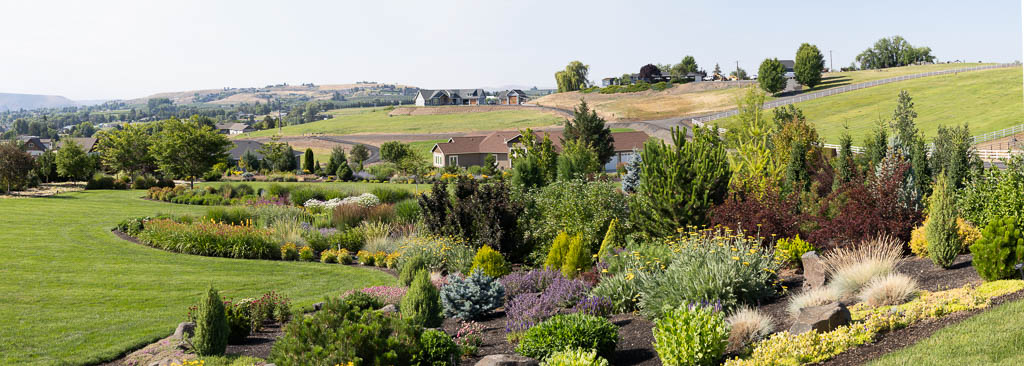
On a crisp winter’s morning, I gaze out over the Heatherwood landscape. I look over our immediate landscape to the hills surrounding our grounds. My eyes stop and become fixated on our neighbor’s beautiful cherry tree. It is the last standing memory of a bygone cherry orchard of the past.
We frequently walk by the tree on the way to pick up the mail. We stop and admire the tree throughout the year. Zelda, our neighbor’s Black Labrador, frequently greets us yearning for a pet.
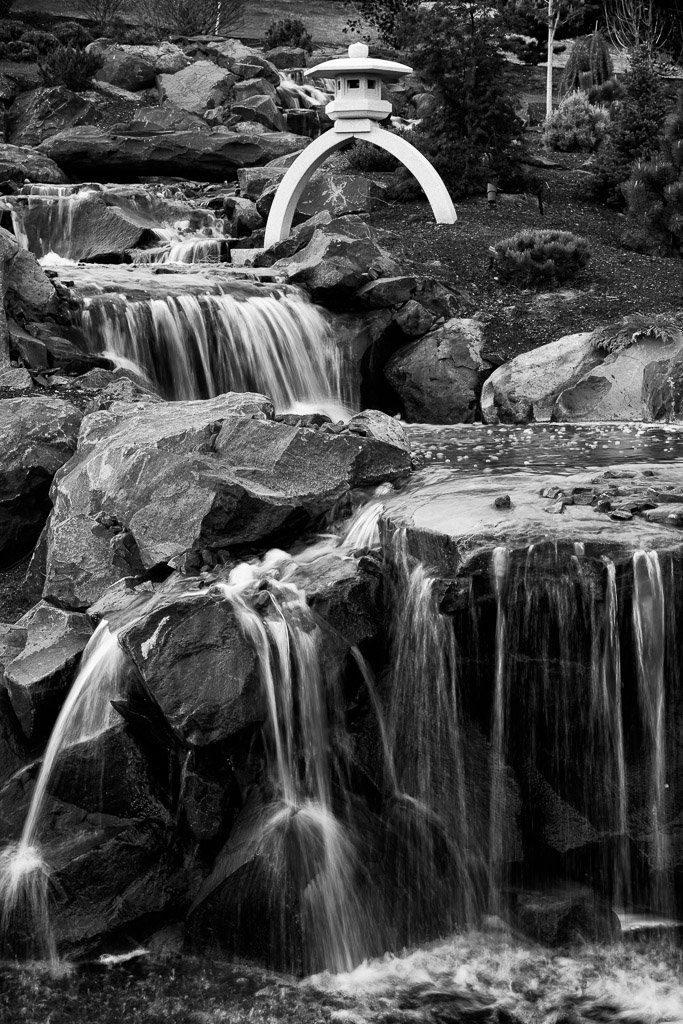
The Kotoji Japanese lantern is probably the most frequent single element that I have photographed in our Heatherwood Japanese Garden. It sits in a prominent spot overlooking the stream and waterfalls. One leg is in the stream while the other sits solidly on land. From every angle it seems to be a sentinel guarding the stream and pond below. The Kotoji can be seen from multiple places around the Japanese garden as well as as from the lower Heatherwood meadow and garden. Even in winter it is a dominant focal point in the landscape. At night its internal light shines through the lantern openings while an external flood lamp highlights the lantern and stream.
Many mornings we have started the day enjoying a cup of coffee overlooking the Kotoji from the “Perch” above. In the late afternoon/early evening we have sat below looking up over the pond and waterfalls to the Kotoji as we sip a glass of wine toasting to another beautiful day.
I don’t know which I enjoy the most: the snow-covered panicle hydrangeas in winter or the profuse white blooms in the summer. Each conveys a different feeling: one a quiet, peaceful, solemn feeling, the other a robust splurge of brightness. The more I think about it, the easier the answer is. I like both for the enjoyment they bring.
We continue to get a little more snow. It is light enough not to incur any real inconvenience. Even though I anxiously anticipate the spring bloom, I appreciate the beauty of the winter season, especially with a blanket of fresh snow. Each season has its unique beauty. All I have to do is to look out our windows to discover little vignettes that highlight our garden.
Hearts and Valentine’s Day go hand in hand. Our Bleeding Hearts (Dicentra) symbolize the Holiday. May your Valentine’s Day be a beautiful one filled with love and happiness.
A Little Trivia on the “Romantic” Valentine’s Day
The romantic Valentine’s Day was first brought to the public’s attention by Geoffrey Chaucer in his 1375 poem “Parliament of Foules.” Valentine’s greetings were introduced in the Middle Ages. Written greetings came after 1400. The oldest existing greeting is from 1415 in a poem by Charles, Duke of Orleans to his wife while he was imprisoned in the Tower of London.
Valentine’s Day celebrations began in the 1600’s. The next century small tokens and handwritten notes were popular. Printed cards started to replace handwritten notes by 1900. Printed cards along with lower postal rates contributed to sending Valentine’s cards by mail. Ester A. Holland introduced mass-produced Valentine’s Day cards in 1840. Today an estimated 145 million Valentine’s cards are sent each year.
Berginia and Yellow Twig Dogwood Heatherwood Winter
The deep reddish purple winter color of the bergenia provides a striking contrast to the yellow winter color of the yellow twig dogwood. In the spring the Bergenia turns to a deep green as it prepares for its deep pink flowers. Spring brings green leaves and white delicate flowers to the dogwood. Over time we plan to add various ground covers to provide additional color and texture contrasts.
Dwarf Blue Spruce and Ice Plant Heatherwood Winter
We are now in the middle of winter. The temperatures are down in the 20’s and it is snowing again. My mind goes back to last weekend and the almost tropical weather (in the 40’s & 50’s) we were having. We had just completed marking out locations for trees and shrubs that we plan to add to the Japanese-style segment of the garden. We are ordering plants now for our spring project. Planting should start in about another month and a half.
Winter color is scattered across various parts of our Heatherwood garden. In one corner of the garden, we have a small planting area of dwarf conifers. Between the conifers we have added various ground covers. This image shows the contrasting colors of the dwarf blue spruce and the red winter color of the ice plants. In the spring, the ice plants turn to a light yellow-green tone providing a different striking contrast to the spruce’s blue.
Just before the arctic blast is suppose to hit us, our witch hazels are blooming. Over the years, witch hazels have been the harbinger of the coming spring in our winter gardens. We planted our first witch hazels in our Woodinville, WA garden. They were planted them later in the spring after their blooms had been replaced by leaves. I didn’t know what to expect the next winter, but in late January we were pleasantly surprised by the little fragile blooms. When we lived in the Philadelphia area, we frequently made the adventure down to Longwood Gardens to see and photograph the displays of large (10 foot) yellow, orange, and red witch hazels. Here at Heatherwood, we planted six Diane and Jelena witch hazels last spring and are enjoying their first winter bloom now. Our little guys are only 12-18 inches tall. They look a little lonely in the large open planting areas. Looking back on the Longwood Garden specimens, I can visualize the beauty in which they will grace our winter garden as they mature.
Looking out over our front yard, I reflect on memories of bygone childhood years. Outside our farmhouse door, in the foreground I see the snow covered apple trees with a few remaining apples hanging on the wild branches that need to be pruned. A little farther out I see our neighbor’s newly planted apple orchard. Behind the new apple orchard, I reminisce running through the old cherry orchard looking for low hanging delicious treats. And above the cherry orchard, I dream of the hours I would spend roaming around the sagebrush hills behind our orchard.
I enjoy looking over our Heatherwood landscape as I appreciate the borrowed views from our neighbors’ properties.
Winter is beautiful at Heatherwood. This is the morning view from our patio following a winter snowfall. Many people can’t wait for spring. I enjoy each day in winter as it gives the garden a chance to rest. Each day is a gift.