Category Archives: Our Garden

Images taken in our Pennsylvania garden

Why Did I Create This Image?

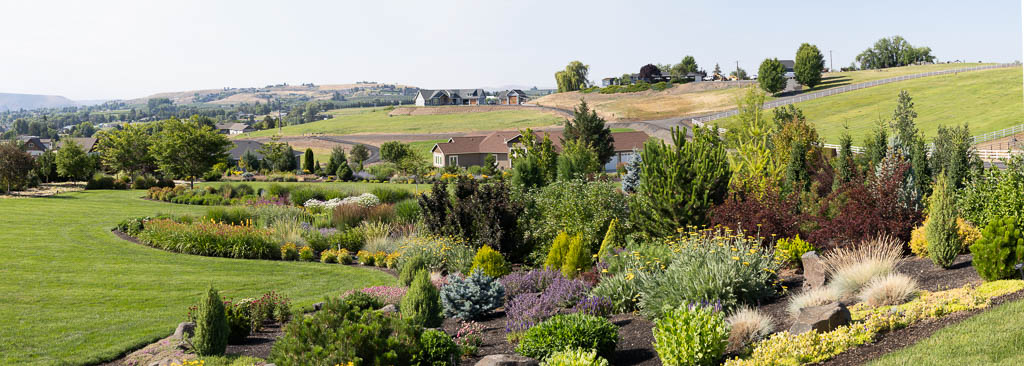
“Selah Butte”
Heatherwood Summer

Our current “stay at home” and “social distancing” environment does have a few advantages. It gives me the opportunity to refresh some of my photography lessons. David duChemin, one of my instructors, stresses that to make a meaningful/compelling photograph, a photographer must first have a vision. That vision translates to having an intent for each image that is taken by a press of a cameras shutter.

This same thought is directly applicable to designing a landscape. When we first started designing our future arboretum one of the first things we did was to walk around the property to identify what scenes we wanted to protect and emphasize from potential “viewing rooms.” Selah Butte and the old Naches-Selah irrigation flume was a mandatory view. We picked a point near the southwest corner of our open lower lawn to build a protected viewing point. This point is where this image is taken from. We designed a planting area behind this point, an oval patch of lawn in front, and other curved planting and lawn areas between to develop a little room. In the back of the room, we planted trees to create shade from the afternoon sun. We framed the view of the butte with an oak and a Katsura tree. Other trees in the mid-ground have a limited height and will not interfere with the view. The summer sun rises directly over the butte. The setting sun lights the hillside up with a warm orangish glow. It will be a great place to welcome the rising sun with a cup of coffee as well as a peaceful place to enjoy a glass of wine as we enjoy the warm glow of the setting sun.

Now, let’s get back to the original question, “Why did I create this image?” My intent was simply to create a baseline illustrating the view that we have at the completion of our first phase of our Heatherwood’s landscape design. The image was created mid-day on the first day of summer 2020. I plan to develop a history of the passing of the seasons, morning and afternoon perspectives, and maturing of our Heatherwood arboretum over time.

Related Images:

“Beardtongue”

“White, Pink, and Burgundy”
Heatherwood Summer

The “Eastern Smooth Beardtongue” (Penstemon laevigitus) is one of our garden’s first bloomers. its three foot tall burgundy stems host brilliant white and pink flowers in the middle of the meadow.

Small beautiful vignettes like this help me focus on what is right with this world as I let go of the many difficult things we are all facing. Beauty is all around us, we just need to open our eyes and hearts to recognize it.

Related Images:

More Meadow Color

“In the Meadow”
Heatherwood Summer

Here is to more color in the meadow. This time we’ve added a little orange to the yellow and purple. The patches of color are separate, but gently blend into one another. The yellow provides a little buffer between the orange and the purple. What a summer treat our new meadow brings us.

Related Images:

Monet’s Yarrow

Yarrow in the Meadow”
Heatherwood Summer

This image continues the theme from my previous post. The colors in our new meadow are striking. Adjacent colors were actually laid out using a color wheel. Here, opposite colors were planted next to each other to create the color contrast. Here again Monet’s perspective comes to the rescue.

Related Images:

Monet’s Interpretation

“The Meadow”
Heatherwood Summer

We just finished carving out and planting a new meadow in the lower section of Heatherwood. The colors are already bursting out for its first summer season. Reds, purples, yellows, blues, oranges, and all different shades of greens are scattered about. We have a lot of bark covered ground showing through most of the areas. It will take a few years for the perennials to fill in. We have patience and are enjoying the individual plants as each one breaks into bloom. Hopefully we will have a flow of changing color throughout the summer and early fall. This is just a start. We will record the activity of the meadow and adjust as we go along. It will also be a “Never Ending Journey.”

I created this image today. It was my first time out photographing since I had my foot operation. I’ve been hobbling around for the past three plus weeks. I still can’t put any weight on my foot, so I got a little creative and hopped on my lawn mower and drove around our new garden meadow. I stopped and recorded many images from above. Getting the best perspective and composition was very difficult, and sometimes impossible. But, I just had to get out with my camera. When I started processing the images, I noticed that they were all a little out of focus. I guess the high frequency vibration of the lawn mower didn’t help my unsteady hand. So, I decided to cheat a little and convert the images into a blurred impressionistic versions. Thank you Topaz!

Related Images:

Isolation #2

“Past, Present, & Future”
Cherokee Dogwood
Heatherwood Autumn

This is another example of “Isolation.” My mission for this photo excursion was to collect isolated macro images that represent the early autumn of our Japanese Garden. I am in the process of preparing annual image collections of how our Heatherwood Garden changes from season to season throughout the year. For this specific photo shoot, I walked around the Garden and tried to collect compelling images that would represent the details of our autumn garden.

The uniqueness of this image is that is illustrates the yearly life cycle of a dogwood tree bloom. The yellow protrusions are the remnants of the spring blossom sepals; the leaves are turning to their autumn color before they fall for the winter; the red berry is the fruit for the wintering birds, and the purplish bud is the future blossom for next spring. The dew drop adds additional interest while the tips and edges of the leaves draw the viewers eye to the subject.

Related Images:

Isolation

“A Peek of the Kotoji”
Heatherwood Fall

I have recognized that I have recently fallen back on making nice snapshots versus compelling images. I tend to fall back into “ruts” from time to time. During this period of “social distancing” and my surgery recovery time, I am looking back on some lessons I have taken on-line from David DuChemin.

The focus on this image is “Isolation.” My exercise last fall was to isolate and enhance the subject and eliminate distractions. My target subject was the Kotoji. I walked around our Japanese Garden to first identify a perspective of the Kotoji that was different from the many that I had taken before. I collected images of a tightly cropped full Kotoji lantern, close-up of detailed Kotoji elements, the Kotoji with the foreground and background, etc. I then continued to walk around and tried to frame the Kotoji with other elements in the Japanese Garden. Finally I worked on creating a “peek” of the Kotoji through a background Japanese maple.

To focus on the subject, I set my focal point and exposed for the front edge of the lantern’s top. The lantern was framed with a void through the Japanese maple. I used a narrow depth of field to blur the maple tree leaves and branches. In post processing, I further blurred and darkened the surrounding leaves and branches to lead the viewers eye to the Kotoji.

This image is not one of my best, but it was an excellent learning experience to purposefully focus on creating a compelling image.

Related Images:

Dogwood

Dogwood Bloom Against Japanese Maple
Heatherwood Spring

As I stroll along in our Heatherwood Garden, I always have a camera, at least my iPhone, with me. This Spring, our variegated dogwood only had a few blossoms and they were 7-8 feet from the ground. I looked around to see if I could get a good sky background, but all we had were grey nondescript clouds. I stood on my tip toes extended my arms and tilted the iPhone down just a bit to pick up the deep red of a Japanese Maple as a background. It pays to be tall.

I don’t have to go far for a photographic safari. Everything I need is in our back yard.

Related Images:

Shin Deshojo

Shin Deshojo Japanese Maple
Heatherwood Japanese Garden

How fast things change. The initial color of the first emerging leaves of this Shin Deshojo is a light pinkish red. Within a week they had turned to this brilliant red. Now, a month later, the leaves are a greenish-red color. Soon they will be a medium green. And then in the fall, they will be a brilliant red again. What a wonderful show this little tree gives us over the year.

The different and changing colors of our 26 Japanese Maples consistently catch my eye. Every time I walk through the garden, I look for something different. It is easy to find.

Related Images: