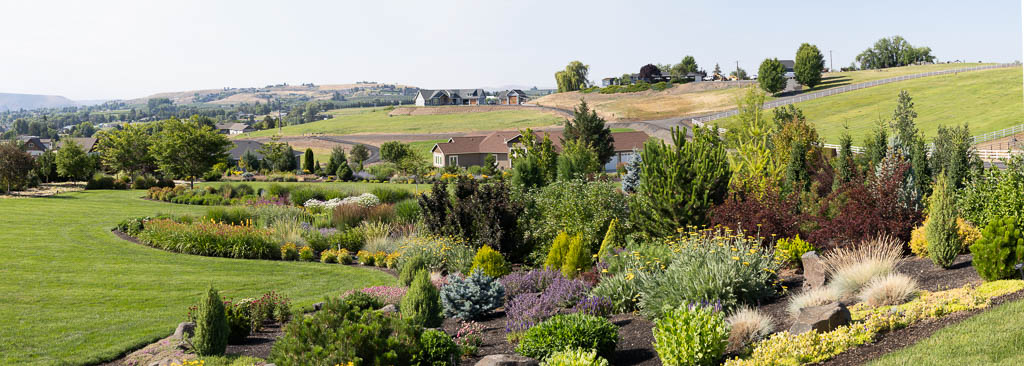
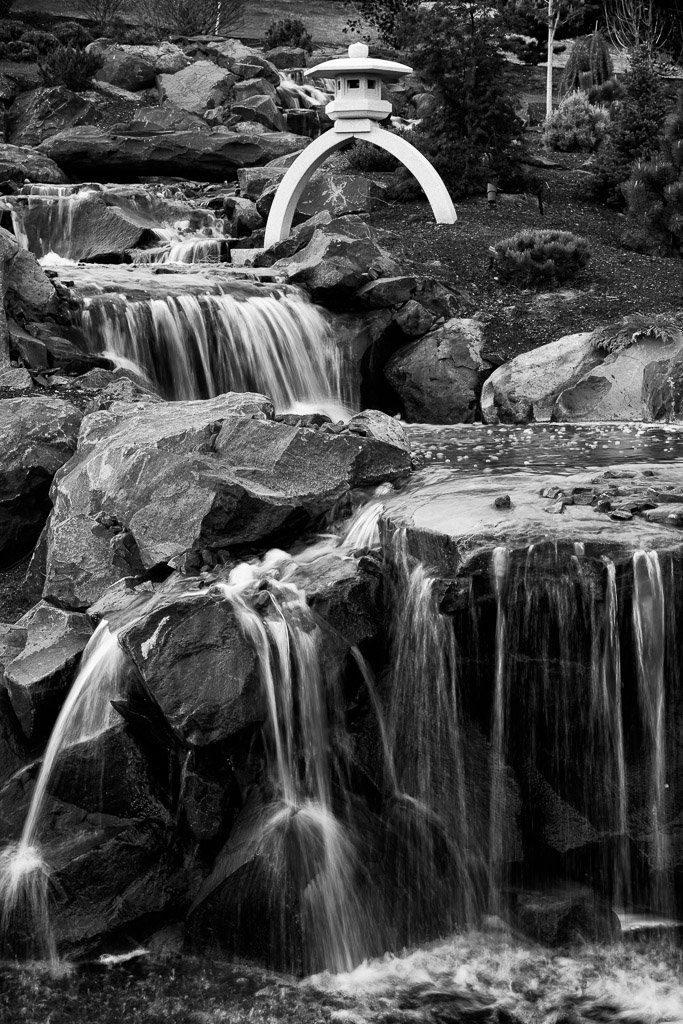
Our visitor leans back in the Adirondack chair, his/her head turns from left to right wandering up over the landscape. There is so much to see. But soon the attention focuses on the main waterfall and the Kotoji lantern guarding the stream. The rushing water and roaring sound hold the viewer’s attention. The Japanese maples and surrounding evergreens frame in the waterfall and pond.
Our visitor notices another Adirondack chair up above at the top of the stream. Curiosity arises, “How do I get up there?”
“The Waterfall & Pond” Heatherwood Japanese Garden
Catching a glimpse of the waterfall and hearing the sound increase our visitor picks up the pace around the curving path. The garden opens up and presents its star attraction. It is time for the stroller to catch his/her breathe and sit down in one of the Adirondack chairs to just relax and take in the scene.
This is one of the views we have for our morning cup of coffee and an afternoon toast of wine. Our Japanese Garden stream and pond area is starting to slowly fill in. The shrubs and ground covers we planted are taking hold and covering many of our open areas. This year we added eight trees, multiple shrubs, kinnikinnick, cotoneaster, and thyme around the stream and pond area. In addition, we planted several screen trees and shrubs around the top of the garden to shield the view of our neighbors home from the bottom of the pond area.
Next year, we will continue to add ground covers. Then as the trees get larger and produce a little shade, we plan to add rhododendrons, azaleas. and other shade plants to finish off the Japanese garden. And, I’m sure we will find space for a few more Japanese maples.
“Left to the Pond – Right to Continue” Heatherwood Japanese Garden
After catching a glimpse of the water, our stroller continues down the curving path to come to a second division. The rushing water and the waiting Adirondack chairs pulls him/her to the left. The Oribe guide post, Tetsu Bachi basin, and Kakehi water spout draw the guest in to prepare for a relaxing pause.
As time passes and the young trees mature, they will enclose this sitting area and make it more private. But for now, it is pretty much wide open and provides a wide angle view of the Japanese Garden’s star attraction.
Our guest takes a couple more steps down the path and glances left … SURPRISE! A small window opens up and the source of the sound is exposed. As the water rushes over the rocks, a small Yukimi Japanese lantern projects out guarding the pond. The vignette is just a teaser of what is to come as one strolls further down the path.
A decision is made, the visitor follows the sound of water and takes the lower path to the right. Ahead, the path gently curves then divides again. To the left is a sitting area and to the right is a path to the exit of the Japanese garden. Dividing the path is a planting area with a Japanese lantern and wash basin, a Japanese maple, and a weeping larch. A large linden tree and blue spruces provide a background. The stroller can still hear the water but cannot yet see the source of the sound.
Walking further down the entry path, the stroller now needs to make a decision: right around the hill or left up the hill. The design for this division in the path hides what is beyond. The stroller needs to decide to follow the sound or climb to get a better view. The little lantern marks the decision point as well as provides light in the evening. The extended limbs of the Shishigashira Japanese maple behind the lantern seems to point to the two different paths.
Across the path from the Hokkoji, a Hana Matoi Japanese maple, captures our strollers eye. It is planted on the hillside and surrounded with rocks, ice plants, and thyme. The vignette created by the maple and ground covers can be seen from multiple spots through out the Japanese garden. It is one of the key focal points of interest. Below are a couple of highlights:
After being welcomed by the Hokkeji lantern, the “Hill of Learning” presents itself to the garden guest. Looking up the hill left of the gravel path, a stroller may notice two rock groupings. The one to the right is composed of five rocks following the informal path up the hill. The large one on the bottom represents a knowledge seeker. The other four symbolize steps on a never-ending path of learning. To the left of the informal path is another grouping of five rocks. The top rock represents a teacher while the other four symbolize students surrounding him/her.
I look out my office window to this hillside every morning as I make my journal entries. Often I daydream about how much I still have and want to learn about the world that surrounds me. The landscape looks a little sparse now, but over time we will fill in the voids to highlight the message from the rocks.
Today’s post presents Heatherwood’s Japanese Garden mid-summer status. We have had some plant damage from the record high temperatures in June and July and the severe drought since March. But we are lucky to have an adequate supply of irrigation water. Overall, the garden has survived fairly well.
Five years ago when I moved in, this area was all green grass. That year I planted a single Japanese maple and an October Glory maple in the grass lawn area. The following year I started creating a small Japanese-style garden including additional Japanese maples and the foreground stone path and weeping white pine. Two years ago we removed the lawn and built the hillside garden, stream, and pond, and planted the Japanese garden foundation trees and shrubs. Last year we added ground cover and a few additional shrubs. This year we added several more structural trees, evergreen and deciduous shrubs, and additional ground cover. Most plants are taking hold and are growing to fill in the garden space.
We enjoy the garden every day as we stroll around it and inspect the changing growth of the vegetation. Many mornings, we sit in the garden with our morning cup of coffee and plan the day. Frequently we end the afternoon with a glass of wine sitting by the pond and looking up at the cascading water of the stream.
This small Japanese lantern and the rock marks a division in Heatherwood’s Japanese garden. Which path do I follow? Do I take the easy path toward the sound of the water? Or do I venture up a curving path to explore up above? Each path has its own little surprises. Take your choice …