“Yellow Twig Dogwood & Red Bergenia” Heatherwood Late Fall
Growing up, my favorite colors from my color crayon box were yellow and red. They were always the first crayons to be used up. It doesn’t surprise me that we have this color combination throughout Heatherwood. The bright red bergenia and the yellow twig dogwood provide an interesting contrast in both color and texture. Now we just need to add green ground cover to complete the vignette.
As we designed Heatherwood, we set a criteria to have varying color during all four seasons. To help accomplish this we planted an assortment of red twig, yellow twig, and multi-color twig dogwood shrubs throughout the garden. Several have already grown to the three-foot level like the red twig in the image above. They provide stand alone color as well as a screening effect in the garden. It will take two to three more years to get the full benefit of these shrubs.
After two weeks of vacation, we are missing our Heatherwood home. We look forward to see how much has changed during our absence. With a serious wind storm, we expect that all the leaves on the trees have fallen and the shrubs and grasses have been weather beaten. I am sure that this scene will be quite different when we return.
This section of our lower Heatherwood garden provides a layered transition from the perennial meadow to a specimen tree area. It divides our eastern and western lower garden areas. Perennials like the Karl Forster grasses and yarrow transition to deciduous shrubs (elderberries, red twig dogwoods, and yellow twig dogwoods) then to background evergreen junipers and pines. The various structure, texture, and color provide interesting contrasts.
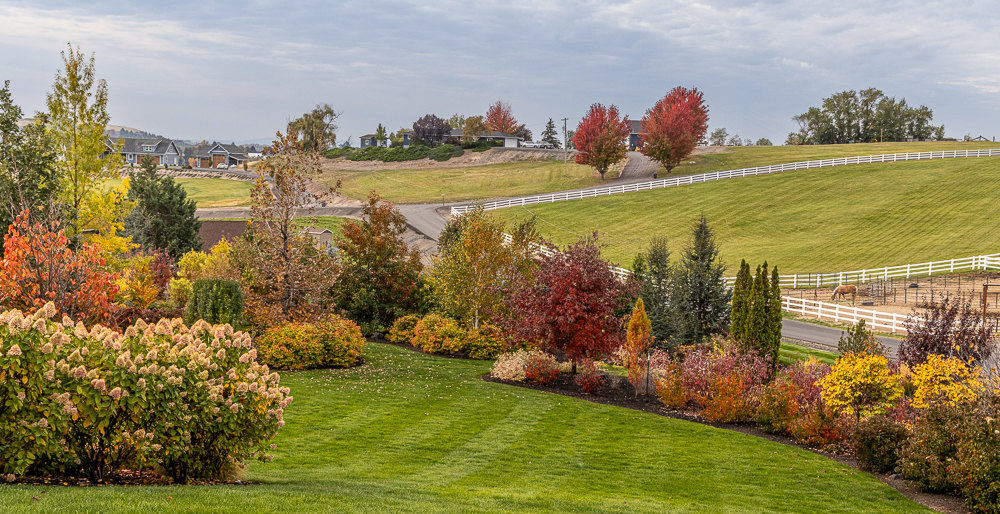
Color, color, and more color highlights our Heatherwood meadow. This area is only two years old and has already surpassed our expectations! The meadow has different colors and feelings during all four seasons. Each season has its special accents. Most people favor the late spring/early summer with all the bright colors of the flowering perennials and shrubs. But, my favorite season is the fall with its more subdued shades of yellows, golds, oranges, and browns. And of course, the bright purples and golds fit right in with my University of Washington Husky bias!
The meadow area weaves in and out creating an interesting flowing border for the lawn area. It provides a fun path to practice my lawn mowing skills. I take my time around the edge, not because it is difficult to mow, but because I just like to take it slow as I enjoy something new each time I make the pass.
Various paths weave their way through our Heatherwood garden. Some of the paths are formal stone paths, some are gravel, some are bark mulch, and some are simple unplanted passage ways through the various plantings. Most paths wind through planted areas to destinations unknown. The paths are not designed to get from point A to point B. They are laid out to provide different views and perspectives as one strolls through the garden. There is usually a little surprise around each corner.
I usually start my day writing in my office when it is dark outside. I take time, sometimes listen to music, and think about what is most important to me. The sun slowly rises above the surrounding hills, then lights up our Heatherwood yard. I turn around from my desk, sit back, relax, and gaze at the beauty of the scene in front of me. I get charged, get a quick bite to eat, then grab my camera to go out and become one with nature. What a great way to start the day right!
This image was created about twenty feet from the image in yesterday’s post. Instead of focusing on a single hydrangea looking through the garden, I stepped back and framed the historic Selah-Naches irrigation flume with the cherry trees and the row of hydrangeas. Borrowed scenes always add interest and enjoyment to our garden.
This fall will probably be the last time that the historic flume will be seen from our garden. It is scheduled to be replaced with a pipe line this winter. Progress is painful!
Some views in our Heatherwood garden provide a glance through the garden to a borrowed scene of the surrounding hills. Other views, like the one above, provide a “stop dead” vignette of a specimen plant surrounded by companions and a deep background of color and contrasts. The ‘Lime Light’ panicle hydrangea is clearly the star of this image. In the summer, the blooms emerge bright white with a little lime green tinge. As the summer progresses they become even brighter white. In the late summer/early fall, they start to turn slightly pink. Later in the fall, the blooms turn brown and the leaves change into their fall color. Then in late autumn, the leaves fall, leaving the bare stems topped with spent blooms which provide a structural interest for the winter.
The companion plants provide depth and a stage for the star. The color and varying textures of the rudbeckia, Russian sage, yellow twig dogwood, and other perennials provide the frame. The grasses, various shrubs, and trees complete the background adding depth to the vignette.
As we walk through the garden, new and different scenes appear daily.
Developing a garden is an evolution of ideas and time. Our Japanese-influenced garden started with my first planting of a Bloodgood Japanese maple in 2016. Additional trees and shrubs were added as I created a small section of garden next to the house in 2017 and 2018. In 2019, my ideas expanded to create a large Japanese style garden on the north section of our property. The concept of Heatherwood began. We converted a grassy slope into a large rock garden, complete with a pond, stream, and waterfall. Monsterous excavators reshaped the landscape. We planted the foundation trees and conifer shrubs for the garden. The foundation was complete, but there were many open areas to be finished. The work had just begun. In 2020, we added several ground covers around the garden pathways. This year we continued with the ground covers, additional border and shade trees, along with many evergreen and deciduous shrubs intended to fill in space and create a little contrast and multi-seasonal interest.
This little red twig dogwood was planted this spring. It looks small now, but when mature, it will reach 5-6 feet tall and wide. In the spring and summer it has light green foliage contrasting with the darker green conifers. In autumn, it is turning into yellow and red shades. In winter, its red stems create a beautiful contrast, especially when the ground is covered with snow.
The garden will continue to evolve. Each year we will add ground covers and additional fill-in plants. As the shade trees grow, we will replace sun loving specimens with shade specimens. Rhododendrons and azaleas are in the plan once we have enough shade to protect them. Developing the garden will be a never ending activity of joy.