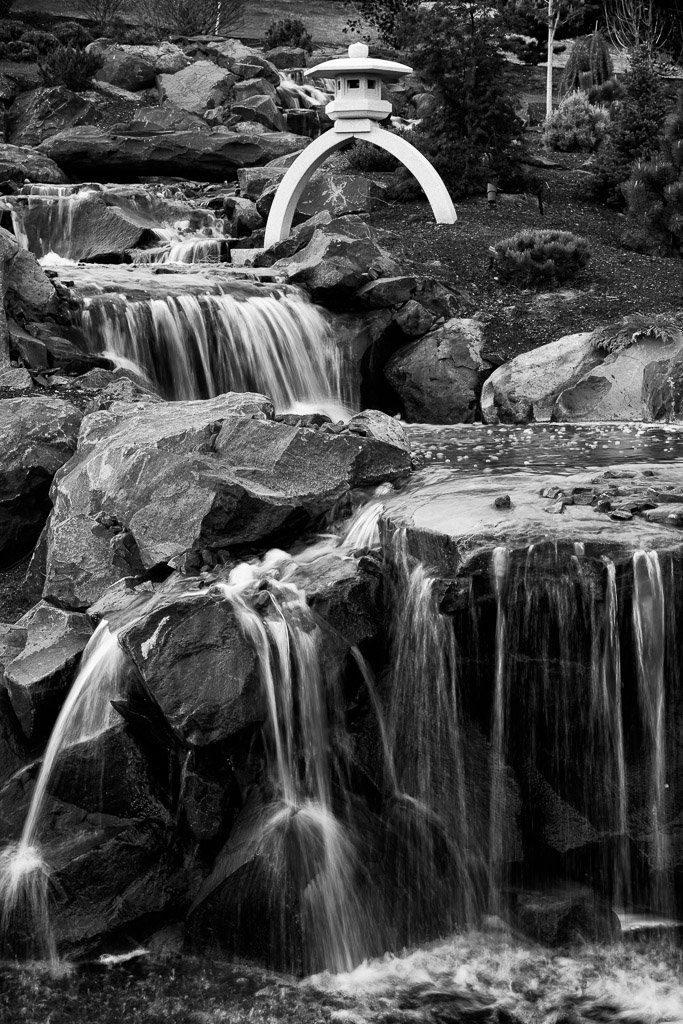
I wanted to practice my long exposure techniques. What a better place to work than our Japanese Garden waterfall. My target was to create a soothing feeling of a small segment of our stream as it falls into the pond. I liked how this section of the stream flowed over the edge and bounced off an intermediate rock before it scattered over a rock in the pond.
I casually walked home through cherry orchard, taking my time and looking all around me. I looked up and saw this protrusion of Selah Ridge overlooking the orchard. I felt like it was a sentinel watching over the rows of trees getting ready to bloom. Blossoms should be emerging very soon. I will keep my eyes open so I can take another adventure through the blooming orchard.
During my walk to the top of the cherry orchard I found a new way to get up to the top of Selah Ridge that overlooks the hillside where we live. There are so many places around our neighborhood to explore. The trek to the top of the ridge from here will be one that I plan to wander and explore.
Looking at this line of basalt rock, I ask myself how this remnant of a lava flow got way up here. Beneath this level of basalt lay strata of limestone-type sediments from an ancient sea bed. How did a sea bed get up here? Piecing the little that I know of the geologic history of the area, the following is what I think happened: First, this area at one time was under the Pacific Ocean. Then the volcanic Cascade Mountains were formed which separated Eastern Washington from the coastal plain. Later, the Eastern Washington, Eastern Oregon, Southern Idaho basalt flows covered what is now the Columbia Basin. Then the moving continental plates slowly forced up the Yakima Folds creating a line of ridges across south central Washington. We live at the base of one of these ridges.
As I take my walks, my eyes are wandering constantly. This branch on a cherry tree caught my attention. What kind of insect or disease could have caused this? Or could it have been artistically created by someone who was talented with a knife and a small carving chisel?
Looking down on this row of smudgepots from the old cherry orchard brought back many memories of my childhood. Sixty years ago, I can remember waking up to skies covered with smoke. A thin film of soot covered anything that was open. The soot could even seep in through cracks into our house. Walking outside I remember feeling the smoke in my lungs. These pots were used to produce heat to protect the spring flowering buds from frost. The oil-burning smudgepots were placed between the rows of trees to produce a warm bed of heat. Cherry trees were the most susceptible to the frost because they typically were the first to bloom in the Spring.
Smudgepot lighting was always a special time when I was old enough to work in the orchards. I can remember hanging out in Grandpa Brown’s bunk house with several other school buddies in an evening when a frost was expected. We were suppose to do homework, but that never happened. We would “horse around” and then try to catch a little sleep. When the temperature stated to drop, we would rush out and light the oil in the pots. We would then monitor the temperature until it rose above freezing. We would then rush back out and turn the pots off. After shutting down the pots we would go home and get ready for school. I left my oily and smoky clothes in the garage. I would shower and get dressed, then head down to school. Most of my school pants were white denims. It didn’t take long to get them covered with the soot left by a previous night’s smudging. After school, we would go back out to the orchards and refill the smudgepots to prepare for the next freeze.
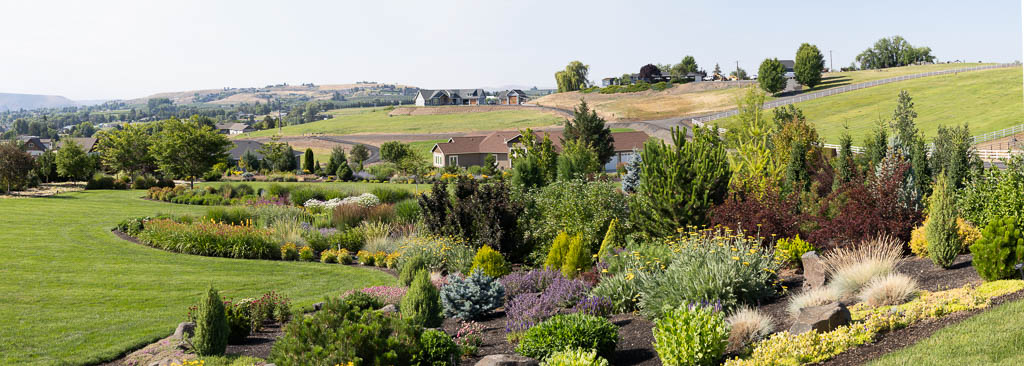
Living out in the country is a wonderful opportunity to get out and explore. I have no excuse to feel “cooped up” inside the house. A 20 minute walk and I am above it all, overlooking an old cherry orchard, the valley below, and the gap to Yakima. How peaceful it is to just stand up on the hillside and observe the wonderful area where we live. In a short time, this orchard will be covered with white and pink blossoms. It is one of the few “old stands” of cherry trees around. Each year they remove a section and plant new trees. Hopefully this section will remain for several years to come.
Naches-Selah Irrigation Ditch Selah Ridge, Washington
We decided to take a walk around our neighborhood hills and orchards yesterday. We discovered that our spring irrigation water had been turned on and had reached the ditch above our home. It is time to start our spring watering cycle. As I’ve mentioned before, this ditch was constructed and put in use in the 1880’s. This is one of the few open areas still remaining. The area directly above our house has an old wood flume. I am looking at it right now from my office as I type this post. It will be replaced by an underground pipe in the next few years. I will be sad to see the trace of our past removed.
“I Can See the Light!” Yakima Arboretum, Washington
The path in front of us may seem daunting. It is dark, winding and uncertain. We have a long way to travel, but there is light ahead. There is a path, we must all pull together, keep our faith, and help each other remain on it. Falling off the path is not an option if we are to reach the light.
The peak of the pandemic is a few weeks ahead. Maintaining our social distance from each other is critical to minimizing the size of the peak. Let’s all stay on the path!
This image is another perspective of the photograph in my prior post. It is also an infrared (IR) image, but processed in black and white. This is typically how I handle infrared images focusing on the contrasts of dark sky and light clouds and foliage from the trees.
A positive ramification of our “stay at home” order is that I can spend a good part of my day working on my photography skills. I enjoy experimenting with different methodologies to create moods and feelings. One of my next endeavors will be to combine IR and long exposure photography into B&W images. Rather than facing each day and thinking about what I cannot do, I much prefer to envision what I can do. It is a time to explore, examine new things, experiment, and learn. I really do not have time to think about what I can’t do.
“For the eyes of the world now look into space, to the moon, and to the planets beyond and we have vowed that we shall not see it governed by a hostile flag of conquest, but by a banner of freedom and peace.”
John F. Kennedy
Six years can make a tremendous difference. When I visited Kennedy Space Center (KSC) in 2014, the attitude of many of the KSC employees was very negative. President Obama had recently cut significant funding for NASA and the Space Program. The Administration was pushing for commercial ventures to move the Space Program forward. Severe cutbacks were being made across the Program. Many KSC employees did not see a future ahead for them.
This March during our visit to KSC, things seemed quite different. There was a a flurry of activity preparing for future launches. International commercial joint ventures had taken over the responsibility for commercial launches. Programs are being put in place to return to the Moon and to launch manned space flights to Mars. Global governmental and private entities are binding together to tackle this venture. Funding is being provided by private, commercial, and governmental sources.
Where have I been? I am embarrassed to say, but my eyes have been closed to news regarding the International Space Program for years. I was totally taken back to the level of activity going on. It made me want to put my childhood “Space Cadet Wings” back on. Kennedy’s vision is moving forward!