I haven’t had much luck finding rain in our Washington and Hawai’in rainforests. My last five trips have been in bright sunny weather in the middle of dry spells. Even though the weather has been beautiful during my visits, I have missed the solemness of the dark, rain-covered forests and vegetation. I will keep trying.
I only had two hours to see Zion! I took a quick drive around the northwest loop in the park. This was the scene at the turn around. What can I say but I really need to come back and spend several days at one of the largest and most beautiful National Parks in the Country.
Capitol Reef National Park encompasses the Waterpocket Fold. This fold runs about 100 miles north and south. It was formed 50 -70 million years ago along a fault during a mountain building period in the Western states. Movement along the fault created these monoclines rising as much as 7000 feet. More recent activity 15- 20 million years ago of the Colorado Plateau uplift and resulting erosion exposed the surface of the monoclines. As much as 10,000 feet of strata representing 270 million years of geological history has been exposed in some areas.
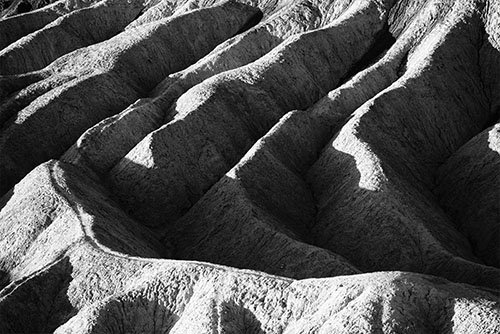
The Badlands were formed by a series of depositions and then erosion. Seventy-five million years ago, the area what is now the Badlands was a part of an inland sea extending from the Gulf of Mexico to the North Pole. The lowest levels are sea bed depositions. From 75 to 45million years ago, plate movement gradually forced up the Rocky Mountains and created a depression which is now the Badlands. During this period, erosion from the raising mountains and volcanic action deposited various layers of material in the depression. Starting about 500,000 years ago the Cheyenne and White Rivers carved out the deep valleys through the area. Torrential rain storms and wind have been eroding the area at a rate of one inch per year.
Crater Lake & Wizzard Island Crater Lake National Park, Oregon
If you you want to see the deepest blue, just gaze into Crater Lake. It is the deepest lake in the United States at nearly 2000 ft. depth. The crater was created around 7,000 years ago when Mt. Mazama exploded in a violent eruption. Local Native American tribes witnessed the eruption and have passed down many legends of how it was created.
Crater Lake National Park was established in 1902 by Teddy Roosevelt as our sixth National Park.
“Looking Up the Throat” Mt. St. Helens National Volcanic Monument, Washington
What an amazing sight from the Johnson Observation Center! The open throat of the mountain takes my breath away and draws me in. I stand in awe looking at the quiet scene, with my imagination going wild thinking of what the observers at this site must have thought and felt when the mountain erupted over forty years ago.
“A Glimpse of Pele’ “ Halemaʻumaʻu Crater, Hawai’i Volcanoes National Park
Halemaʻumaʻu crater, the home of Pele’, lies within the caldera of Kilauea. Pele’, the Hawaiian goddess of fire and volcanoes, was exiled from Tahiti because of her temper. Legends warn one that you better watch out if you meet a beautiful young girl or a white-haired older lady and don’t grant them what they wish!
I created this image from the Kilauea Crater Observation Center four years ago. It was a magnificent sight to see a glimpse of Pele’. This winter, we went up to the crater to find out that the Center and road up to it had been closed due to recent activity in 2018. We could not look down into the throat of the Halemaʻumaʻu crater to see Pele’.
“Mt. Rainer Afternoon Sun Break” Mt. Rainer National Park, Washington
This image was taken driving back down the hill from the “Sunrise” visitors center on the east side of Mt. Rainer. I had just finished a little hike up the side of the mountain to the tree line. Driving back down in the early evening, I looked back in my rear view mirror and saw a little sun break. I found the nearest turnout to enjoy a few fleeting moments before the shadows fully engulfed the mountain.
Every time I drive up to the Mountain it has a different feeling about it. Each facet looks different depending on the time of day and the amount of sunlight or shadows present. It may be covered with clouds or protruding into the clear sky above the tree-covered slopes below. It is a pleasure to just stop and gaze at its majestic presence.
“High-Watermark of Picket’s Charge” Gettysburg National Park, Pennsylvania
This post continues my series on some of our National Parks. Gettysburg National Park has always been one of my favorite places to visit. My first visit was over 50 years ago, back in 1966 when our family took a cross-country vacation in the “Blue Blimp”, a blue and white Dodge motor home. I was fascinated with the battlefield back then. When we lived in the Washington, DC area, we made several trips with our visitors, learning more each time. During our 16 years in the Philadelphia area, we must have made 9-10 visits. My last trip to the park was 2 years ago, when we visited the Washington, DC area. Each time I visit the battlefield, I learn something new and gain a greater understanding of what what this turning point in the Civil War meant to the Country and our people.
This particular site is a solemn point. It was the farthest point that the Confederates made against the Union forces during Pickets charge. The Confederates sent 15,000 troops across this field and suffered fifty-percent casualties. Gettysburg along with the concurrent Confederate surrender at Vicksburg marked the turning point of the Civil War.
“The Race Track” Death Valley National Park, Nevada
What the ????? How did the rock get here? Who or what pushed it? Or was it pulled? Scientists have been studying this since the early 1900’s. Theories have changed over time. In fact, the prominent theory at the time I took this image seven years ago has changed.
The current theory is developed from using time-lapse photography, weather stations, and GPS devices. During the winter of 2013, the elements came together and scientists were able to record the phenomenon of the sliding rocks. During a rain fall followed by an extreme cold night, a thin layer of ice formed. The ice lifted the rocks from the playa surface. The next morning, the ice started to melt creating a thin layer of water between the ice and the playa. The ice sheet started to break up leaving sections of the sheet floating on the water. Winds came up blowing the smaller ice sheets with the embedded rocks across the playa.