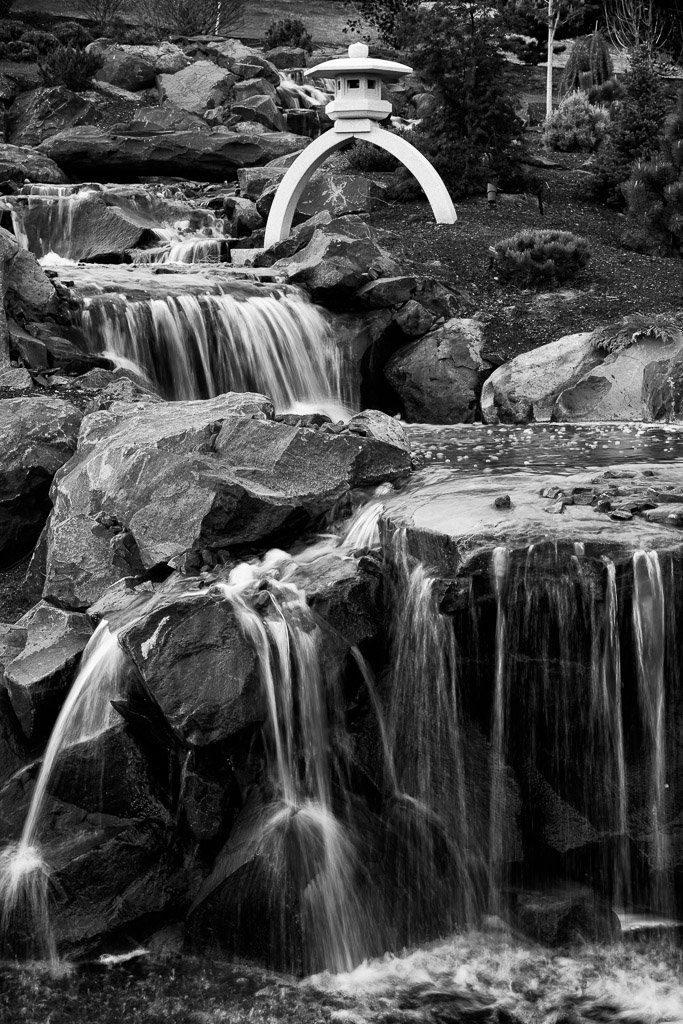
‘Japanese Garden Waterfall in IR’ Heatherwood Summer
I am working hard to learn and experiment what makes an interesting infrared image. I look for contrasts that infrared will highlight. In this image the infrared pulls out the greens and yellows of the trees and shrubs surrounding the dark shade of the pond, rocks, and sky. The reflections from the water makes the stream flowing over the rocks and the ripples on the pond stand out.
This week has been a scorcher with temperatures rising above 105 degrees! By 10 AM, the temperature reaches above 90 degrees. It is really too hot to do much of anything outside. But, it is a great time to create a few infrared images. I need to do a little IR photography practice as I prepare for a workshop in the Badlands of South Dakota in September.
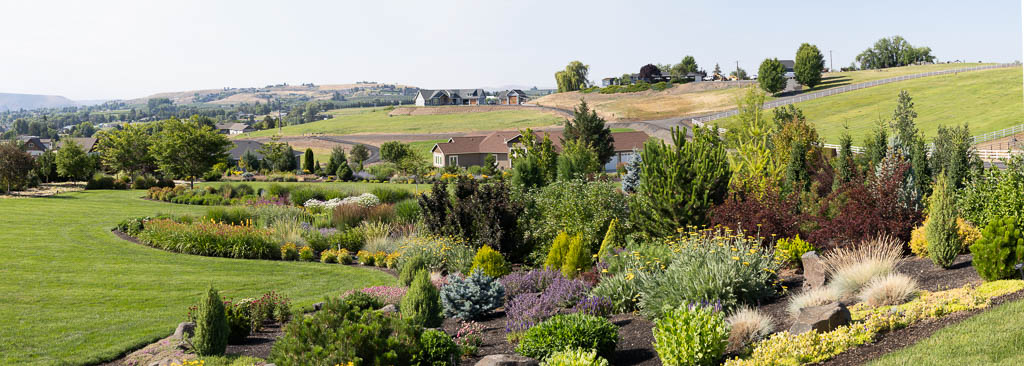
My eyes follow the lawn path through the lower garden up to Selah Bluff on the horizon. The infrared perspective puts me into a dream-like state. I wonder what is beyond the bluff. Beyond, the Wenas valley slopes to the Yakima River. Then another set of ridges rise up then down to the Ryegrass plateau. The plateau rolls along then descends down to the Columbia River. Ridges of the Yakima folds rise up from the river and level off into the farmlands of the Columbia Basin. A few small farm towns sprinkle the basin. Two-hundred miles away lies Spokane.
I then think of the sprawling metropolitan area between Olympia and Everett, and am thankful for where I live. I am a country boy at heart.
Early in the morning on a midsummer day it is wonderful to be out in our Heatherwood garden. After a cup of coffee in the morning, we have our breakfast on the upper patio. This is the scene that we are blessed with. We look out over our lower yard and meadow to the our neighbors pastures. In the distance we see the ridges and the gap between Selah and Yakima. We can’t ask for a better way to start a midsummer’s day.
After breakfast we work/play a little in the garden before it gets too hot. By late morning, it is time to come inside to get relief from the hot sun. Temperatures continue to range between the high 80’s and mid 90’s. We are watering almost continuously twenty-fours a day to keep the lawn green and the plants healthy.
Our Heatherwood meadow is a potpourri of color in midsummer. This vignette is a mixture of yellows from the red hot poker and yarrow, pinks of the Joe Pye weed, blues of the globe thistle, greens and browns of the Karl Forrester fountain grass, and the background greens of the red twig dogwood. It is an eye’s delight!
Mid-summer is the peak of color which gives Heatherwood’s Cherry Allee its nick name, ‘Bright and Shiny’. When we were defining the conceptual design of the lower garden area, we asked Mary what she would like to see. She quickly said, “Something bright and shiny.” Three years after planting, here it is.
We envisioned creating a framed-in colorful view from our house level which included both a near field interest of color as well as a bucolic view of the background farms. Pink Flair cherry trees frame the planting area and lead a viewer’s eyes through the scene to the sky above. The shaped lower lawn separates the foreground from the background. We planted oak and birch trees to separate Heatherwood from the neighbor’s pasture. The trees at the top of the hill provide additional interest as they break the horizon line.
We added ‘sitting rock’ benches at the top of the garden to immerse the viewer into the bright flowers. Lilies planted just right of the stone benches provide a sweet aroma. It is easy to get lost in the beautiful colors and sweet smells.
All season interest was also in our minds when we designed ‘Bright and Shiny’. In the early spring, the cherries break out in beautiful pinkish white blooms. Later in spring the perennials start to bloom in color profession. In summer the perennials reach their peak as different plants come in out of their prime colors. In autumn, the cherry trees and the background trees burst out in brilliant fall color. And in winter, the red bark of the cherries and the yellow bark of the yellow twig dogwoods frame the view while the different forms and textures of the spent perennials provide winter interest. When snow covers the ground and trees it is like a winter wonderland.
In the midst of summer, our historic flume section gets lost in the shadows and the green leaves of the surrounding trees. Standard black and white image processing still does not separate the flume from the surrounding elements. Infrared photography turns green leaves and other green vegetation a white or light grey tone. Now the flume pops out from the surrounding trees and grasses.
I enjoy a nice peaceful day at home. A morning cup of coffee overlooking the garden is a nice way to start the day. After a simple breakfast on the patio, we enjoy a few hours of work in the yard to fill out the morning. A casual lunch in the shade of the patio awning is a good time to think what we want to do do for the balance of the day. Maybe it is running an errand or two, a little reading or computer work inside where it is cool, or maybe even a little nap. Then as the temperature cools down a bit, it is time to mow the yard. A glass of wine or cold beer sitting by the pond is a good way to finish off the afternoon. Finally as we have dinner again outside on the patio, we talk about how great a day it has been.
It’s midday. the sun is directly above, the temperature is close to 100 degrees. It’s not the ideal time to photograph the garden. But wait, the harsh sun reflecting off the garden vegetation and bright blue skies make an ideal opportunity to work in the infrared spectrum. The bright reflections from the grass and foliage contrast with the dark tone of the blue sky providing an interesting perspective.
I was walking among our crabapples admiring the blossoms, turned around and saw this scene of our emerging meadow. Just two months ago, this area was covered with tall winter grasses and dried up perennials. The trees and shrubs looked like winter sticks. We even had a quick dash of late winter snow. What a change in just 8 weeks! This will be the fourth year for our meadow area. Each year the plantings get thicker and thicker. Some perennials die off, others take their place.
This year the heavy snows and late winter freeze took their toll on the ground covers. We are waiting for a few more weeks to monitor how they recover before we take to the shears to clean them up.