Spring through autumn, the rudbeckia provide brilliant yellow color to the garden. Even in their spent form, they provide a bright yellow-brown contrast to the first winter (late fall) snow. Who says a winter garden is dreary?
We received a light covering of snow last night. Once the sun lit up the yard, I grabbed my camera and went out for a little walk before the snow melted.
Why did I take this image? The lone leaf was an anomaly in the snow covered grass. It created contrast. It was a contrast of color (orange vs white), size and shape (large oval vs lines and small crystals), temperature (warm vs cold), and texture (large semi-smooth vs small points and lines). Did I see a leaf or was it a lone colorful object in a sea of white spattered with green protrusions?
Colors in our rock garden continue to change as fall turns to winter. The ice plant ground cover changes from summer’s light yellow green to winter’s bright red. Several of the evergreens turn to bright yellow and yellow-greens for a winter contrast. Perennials change to deep maroons and different shades of orange-browns. Color continues to persist into the winter. What will next month bring?
Morning sunlight sets our birches on fire. Even with the patches of frost on the ground, the birches provide me warmth. Early morning and late afternoon rays highlight Heatherwood’s golden grasses as they rake across the flowing seed heads. Spent, semi-transparent perennial leaves glow as the low light strike them. The few remaining tree leaves flitter as the light is reflected from their shiny surfaces. Nature’s wonders never let me down.
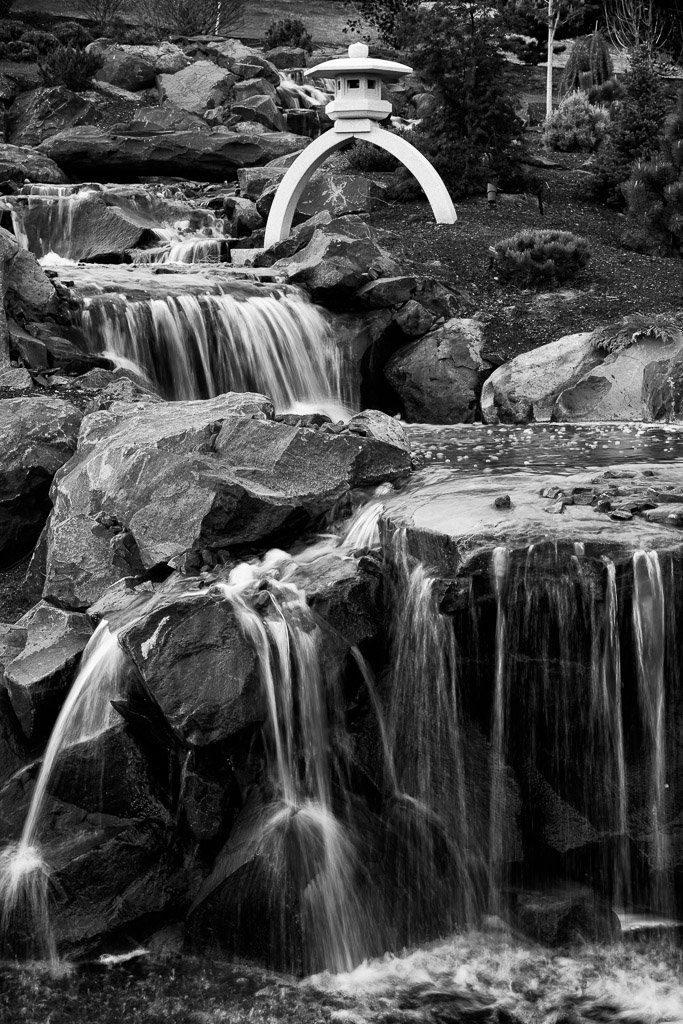
Today I will shut off the final stream of water for our waterfall and stream. The last leaves of the maple are now gone. Sadly it is time to prepare for the freezing temperatures of the coming winter. The memory of autumn’s brilliance against the flowing water of our waterfall will stick in my mind until next spring.
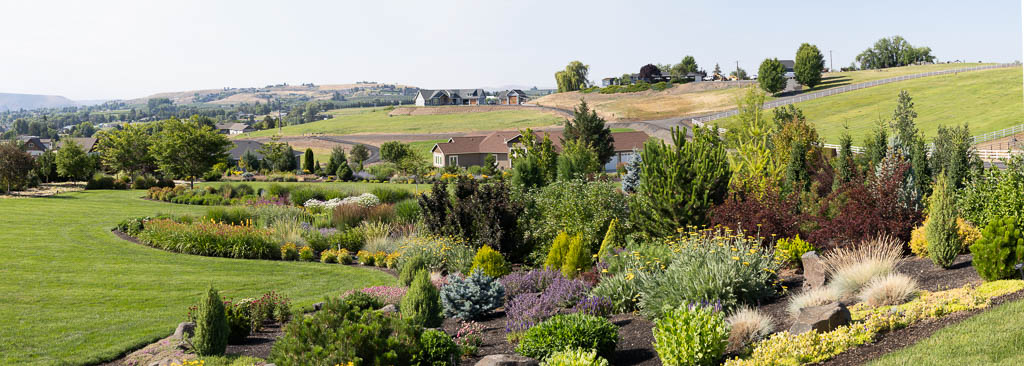
Mary and I enjoy taking a walk from time to time. We really should do it every day. On the road above our home, we get a panoramic view of Heatherwood. I have recorded the view over the time that I have been back in Selah. It is interesting to see how the property has developed over the years.
Limber Pine Cones and Waterfall Heatherwood Japanese Garden
Every time I walk through our garden I get a different perspective. This day, I chose to walk around with my camera and a wide-angle lens. I saw huge (8-inch) pine cones on one of our Limber Pines. With my wide-angle lens, I started searching for something interesting to complement the cones. Moving around the tree, our pond and waterfall appeared.
As I explore our garden I sometimes focus on details, sometimes on wide views, and sometimes on whatever catches my eye. Walking in the garden is always an adventure.
Our Chief Joseph Lodgepole Pines have turned into their yellow winter glory early this year. Last year it was well into January before they reached this bright yellow shade. In April they start to turn light green and gradually turn to full green by summer. They are one of the all-season stars in Heatherwood’s Japanese garden.
Chief Joseph is a dwarf conifer growing only 2-4 inches per year. It reaches about 6 feet at 10 years and can grow to about 20 feet at maturity. Our two trees were planted last year and are about 3 feet tall.
Stream with Autumn Leaves Heatherwood Japanese Garden
Early morning sun highlighted these fallen autumn leaves. They immediately caught my attention and drew me to work the scene with my camera. I walk up to the top of the stream most every day to see and hear the rushing water. I find something new to photograph every time.
The days are getting shorter and colder. Autumn is ending and winter is following close behind. Yesterday we even had a little dusting of snow. I will need to shut the stream and waterfalls down soon to prevent ice from restricting the stream causing the water to overflow its banks. It saddens me to do so, I will hold back as long as I can. It will be mid March until I will be able turn the stream back on.
We are now blessed with a little frost every morning. When the sun comes out, the leaves remaining in the shade retain their frost dusting. There is so much to see. How do I pick what to photograph?
I use a similar technique that some of our forefathers used to find underground water on their land called “water witching.” Their first step was to find a branch shaped like a “Y”. They held the “Y” branches very lightly with the leg of the “Y” facing horizontally in front of them. They would slowly walk across the land hoping that the leg of the “Y” would drop. When it did, there was water below and they selected the site to dig their wells. Now, imagine a camera with a telephoto lens serving as a “witching” tool. I hold my camera lightly with the telephoto pointing horizontally forward. When I feel the lens starting to drop down there is my pile of leaves that I am destined to photograph. “Leaf witching” works for me … or maybe, my arms just get tired.